
Most organizations don’t set out to conflate their portfolio and workplace strategies. It happens gradually, subtly, as language blurs and responsibilities overlap. A real estate team starts referencing “employee experience” in portfolio reviews. An HR director begins citing occupancy rates to justify headcount decisions. Before long, two fundamentally different strategic instruments are being wielded as one—and neither works as it should.
So, what is the difference? A portfolio strategy framework governs an organization’s physical assets—buildings, leases, land, and long-term property decisions—with a primary focus on return on investment and the effective, efficient use of the real estate portfolio. Workplace strategy, by contrast, is concerned with how people experience and use those spaces: the cultural conditions, collaboration models, and human behaviors that drive productivity inside the built environment.
The two are related but fundamentally distinct disciplines. Confusing them—or using one to do the job of both—leads to misaligned decisions, wasted investment, and organizational friction. I’ve spent over a decade working in corporate real estate, and the organizations that get this distinction right are the ones that consistently make better decisions, faster.
Why Most Leaders Are Blending These Two Strategies Without Realizing It
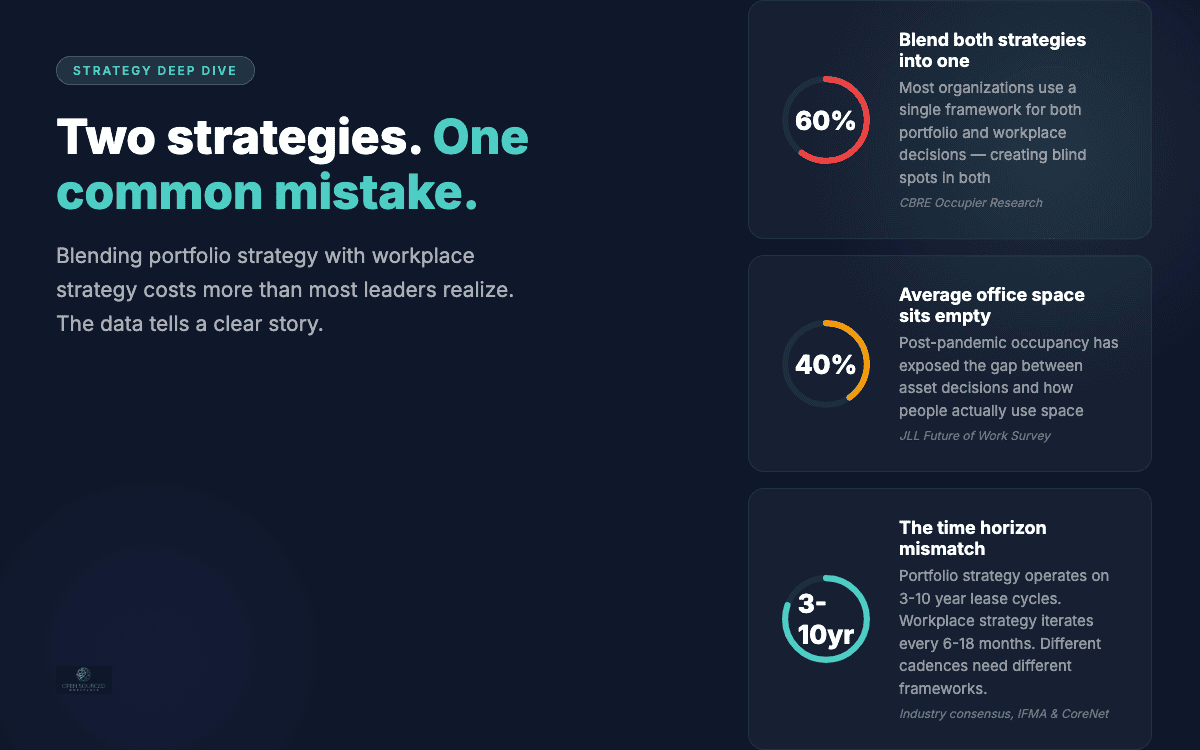
In my experience, the confusion almost always starts with siloed teams and poor communication. Real estate teams make decisions without being properly informed about corporate or people strategy. People strategy teams make plans without understanding the real estate constraints. The two operate in isolation—and then wonder why they keep colliding.
According to research published by the CoreNet Global, a leading association for corporate real estate professionals, the integration of workplace experience into property strategy has accelerated since the pandemic—but without the governance frameworks to keep the two disciplines appropriately separated. The result is strategic noise at exactly the moment organizations need clarity.
How Two Distinct Strategies Got Tangled Together in Modern Workplaces
The entanglement has identifiable roots. The rise of activity-based working, the post-pandemic rethink of the office, and the emergence of chief workplace officers have all placed portfolio decisions and people decisions in the same room. That proximity is valuable—but only when each strategy retains its own logic, metrics, and ownership. When they merge, the intellectual scaffolding collapses.
The pandemic deserves particular mention here. It forced organizations everywhere to urgently rethink both their people strategy and their real estate strategy at the same time. That was genuinely useful—it got people thinking more holistically about how work, people, and place connect. But it also accelerated the blurring of boundaries between the two disciplines, because there was no time to be precise. We’re still dealing with the consequences of that.
What Is a Portfolio Strategy Framework and Why Does It Exist
The Big-Picture Thinking Behind Portfolio Strategy Framework
A portfolio strategy framework is, at its core, a mechanism for governing an organization’s aggregate physical assets across geography, time, and financial obligation. It answers questions at the macro level: How many square feet does the organization occupy globally? Which leases are expiring in the next 24 months? Where is consolidation or exit the most financially prudent course of action?
When I think about the conversations that actually drive portfolio decisions, they consistently come down to five or six core considerations: cost, headcount forecasting, lease expirations, capital investment cycles, talent availability by location, and cost per seat. Not all of these carry equal weight in every situation, but they are always in the room. The underlying goal is never purely cost-cutting—it is maximizing return on investment and creating a more effective, more efficient real estate portfolio.
How Portfolio Strategy Governs Assets, Space, and Long-Term Property Decisions
Portfolio strategy determines the fundamental parameters of the physical estate: location strategy, owned versus leased ratios, capital expenditure cycles, and asset-class diversification. It operates on horizons of five to fifteen years. It is informed by actuarial data, market forecasting, and spatial utilization analytics—not by employee preference surveys.
One nuance that is often lost in this conversation: not all portfolio decisions are purely financial. There are locations that organizations maintain despite higher costs—because of their strategic importance, their brand significance, or their proximity to key customers. When a location provides better service access to clients, or signals something important about the company’s identity and ambition, that justifies a premium. Those are legitimate portfolio considerations, even if they don’t show up cleanly in a cost-per-seat analysis.
Why Finance, Real Estate, and Operations Teams Live Inside the Portfolio Framework
The natural custodians of portfolio strategy are corporate real estate (CRE) teams, CFOs, and chief operating officers. Their decision language is denominated in total cost of occupancy, net rentable area, and lease abstraction data. JLL’s Global Real Estate Outlook research consistently highlights that governance clarity in corporate real estate—including clear separation of portfolio and workplace accountabilities—is a characteristic of high-performing real estate organizations.
What Is a Workplace Strategy and What Problem Does It Solve
Defining Workplace Strategy Beyond the Buzzword
Workplace strategy has become one of the most overused and underspecified terms in organizational management. Strip away the jargon, and it is essentially this: a deliberate, evidence-based approach to designing how, where, and under what conditions people perform their work. It is inherently anthropocentric—concerned with behavior, cognition, culture, and social dynamics.
I think of workplace strategy as a connected web of three things: people, process, and place. The people stream is where HR forecasts what the headcount looks like over the next twelve to sixty months and what roles and skills are needed. The process stream is about understanding what work actually happens in a given location—the tasks, the functions, the collaboration patterns. And the place stream is where the real estate team executes creating the environment that those people and processes need to operate effectively. When all three are aligned, workplace strategy works. When any one of them is missing from the conversation, you end up with spaces that don’t serve the people using them.
How Workplace Strategy Shapes the Human Experience Inside Your Buildings
Where portfolio strategy asks, “how much space do we need?”, workplace strategy asks, “what kind of space enables our people to do their best work?” It examines adjacency planning, acoustic zoning, collaborative versus contemplative space ratios, and the behavioral norms that a physical environment either reinforces or undermines.
Crucially, once a location has been chosen for strategic or commercial reasons—proximity to clients, brand importance, talent market access—it is workplace strategy that becomes the decisive lens. At that point, we are asking: does this environment actually work for the people inside it? Are we designing for their roles, their functions, their ways of working? That transition from portfolio thinking to workplace thinking is a critical moment, and a lot of organizations miss it.
The People, Culture, and Productivity Outcomes Workplace Strategy Is Designed to Deliver
A well-executed workplace strategy measurably affects employee engagement, retention, collaboration quality, and individual productivity. Research from Leesman—the world’s largest independent assessor of workplace effectiveness—demonstrates that workplaces scoring highly on their index correlate with significantly higher self-reported productivity and employee pride. These are not portfolio metrics. They are human ones.
One of the most reliable signals that a workplace strategy is failing. Employees tell you. Directly and loudly. It comes through emails, feedback sessions, exit interviews, and word of mouth. In my experience, employees are very good at letting you know when they are not happy—and very specific about why they cannot do their jobs effectively. The organizations that listen to those signals and cross-reference them against what they already know about the state of their real estate, are the ones that get ahead of problems before they become costly.
Where Most Organizations Go Wrong From the Start
The Moment Portfolio Thinking Gets Mistaken for Workplace Thinking
The misidentification often begins at the brief stage. A leadership team commissions a “workplace strategy review” when what they actually need is a portfolio consolidation exercise. Or they initiate a “real estate optimization program” when the underlying problem is cultural fragmentation and poor team cohesion. The intervention is misdirected because the diagnosis was wrong.
There is also a subtler version of this error: real estate teams making decisions without being properly informed about corporate or people strategy, and people strategy teams making plans without adequate understanding of real estate constraints. The strategies are not technically blended in these cases—they are simply unconnected. And an unconnected web produces exactly the same outcome as a blended one: the wrong decisions, made with the wrong information, at the wrong time.
Real-World Examples of Strategy Confusion and What It Costs
Consider the well-documented case of IBM’s 2017 reversal of its remote work policy. After years of reducing its real estate footprint as part of a portfolio optimization strategy, the company mandated that employees return to physical offices—framing it as a workplace strategy decision about collaboration. Analysts and employees alike noted the incoherence: the physical spaces had been reduced precisely because the portfolio strategy had treated them as cost centers, not collaboration enablers. The two strategies had operated in isolation, and the collision was costly. IBM’s subsequent talent attrition challenges were widely reported, including by The Wall Street Journal.
Why Using One Framework to Do the Job of Both Always Backfires
Each strategy has its own epistemological basis—its own kind of evidence, its own stakeholder logic, and its own success metrics. When one framework is stretched to encompass the other, it distorts the data it was designed to process. A portfolio model that incorporates employee sentiment as a primary variable becomes imprecise. A workplace strategy that is subordinated to lease-cost objectives loses its human-centered integrity.
That said, I want to be honest about something: compromises happen, and they are not inherently wrong. There will always be moments when data points in one direction and stakeholder opinion points in another. There will be decisions made with imperfect information that need to be revisited later. The goal is not to eliminate compromise—it is to ensure that when compromises are made, they are intentional, data-backed, and grounded in both the people strategy and the real estate reality of that moment.
The Core Differences Explained Side by Side
Scale and Scope: Why Portfolio Strategy Operates at the Macro Level
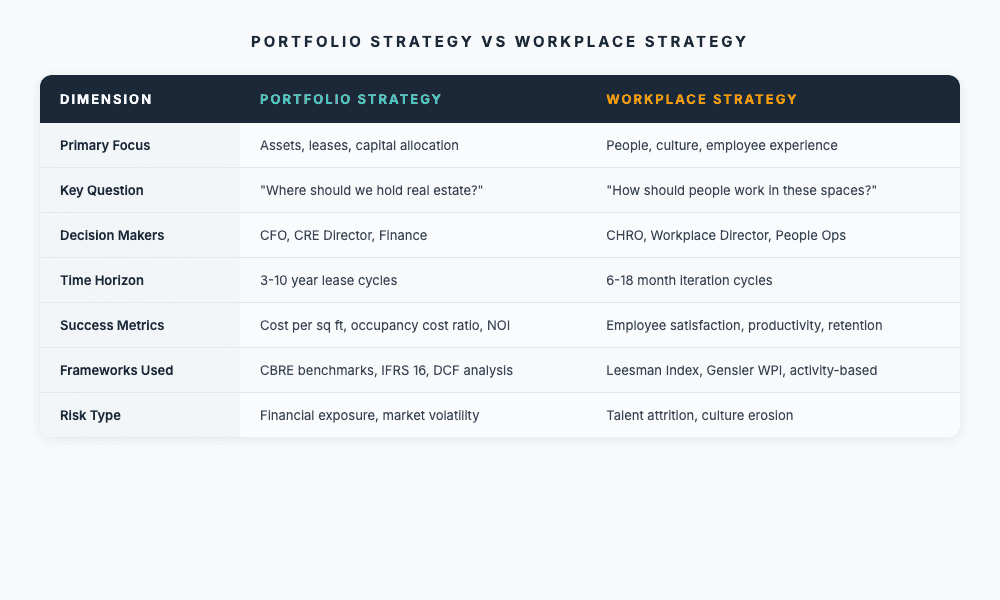
Portfolio strategy is inherently scalable across the enterprise. It encompasses every node of the physical estate—headquarters, regional hubs, satellite offices, data centers, and logistics facilities. Its unit of analysis is the asset or the lease, not the individual employee or the work team.
Workplace strategy, by contrast, is fundamentally granular. It is concerned with the floor plate, the neighborhood, the workstation typology. Its unit of analysis is the person and the team.
Human Focus vs. Asset Focus: The Fundamental Split Between the Two Strategies
This is the axis around which everything else rotates. Portfolio strategy is asset focused. It treats space as a financial instrument. Workplace strategy is human-focused. It treats space as a behavioral environment. These are not competing values—they are complementary lenses that must be applied at the right moments and to the right questions.
I often use an analogy here: consider how a person can simultaneously be a parent, a child, and a sibling. The roles are entirely different—each with its own responsibilities, relationships, and expectations—yet one person can hold all three. The same logic applies to the distinction between portfolio strategy and workplace strategy. The roles are distinct, but that does not necessarily mean the people running them need to be entirely separate. What it does mean is that the thinking and the frameworks must remain distinct, even when the same capable individual is managing both.
Timelines and Decision Horizons That Separate Portfolio from Workplace Thinking
Portfolio decisions are durable. A lease commitment is a five- to fifteen-year obligation. A building acquisition is a generational one. Workplace decisions are adaptive. Furniture configurations, space typology ratios, and collaboration protocols can and should evolve as team structures and work patterns change. Conflating these timelines leads to the wrong decisions being made with the wrong urgency.
When an organization genuinely gets the alignment right between these two disciplines, the benefit is planning visibility. We can look eighteen months ahead, thirty-six months ahead, forty-eight months ahead, and have reasonable confidence in our real estate commitments and our people commitments. That forward visibility is not just comfortable—it is strategically valuable. It reduces firefighting, enables better capital allocation, and allows you to prepare the right spaces for the right people at the right time.
Who Owns Each Strategy and Why That Ownership Matters
Portfolio strategy is typically owned by the CFO or head of corporate real estate. Workplace strategy is most effectively owned by a chief people officer, chief workplace officer, or head of HR, in close collaboration with design and facilities teams. In many well-run organizations, the two functions can be managed by the same capable individual or integrated team—provided the distinct logic of each discipline is preserved. What matters is not how many people are involved, but whether the frameworks, the data, and the decision criteria remain clearly differentiated.
How Portfolio Strategy Framework Shapes Physical Decisions
Lease Management, Asset Consolidation, and Space Rationalization Explained
Portfolio strategy manifests in decisions about lease abstraction—the systematic extraction and analysis of lease obligations to identify risk, opportunity, and optionality. It shapes asset consolidation programs that reduce the number of occupied locations in favor of fewer, higher-performing sites. It drives space rationalization initiatives that reduce the total square footage an organization carries on its balance sheet.
When to Expand, Exit, or Optimize Your Property Portfolio
The portfolio framework provides the analytical scaffolding for three fundamental decisions: grow, divest, or optimize. Growth decisions are driven by talent market access, proximity to clients, and operational capacity requirements. Exit decisions are triggered by underutilization, lease expiry, or strategic footprint realignment. Optimization sits between the two—reducing cost within an existing footprint without exiting it entirely.
An important nuance that gets overlooked: talent availability by geography is increasingly driving portfolio decisions. Where are the skilled people we need, and can we access them from this location? In some cases, that question leads to maintaining a higher-cost location because the talent pool there is simply not available anywhere cheaper. The portfolio framework must be sophisticated enough to accommodate that kind of strategic thinking—not just optimize for square footage and lease rates.
The Financial Metrics That Drive Portfolio Strategy Decisions
Key performance indicators in the portfolio framework include total cost of occupancy (TCO), cost per seat, net rentable area (NRA), occupancy rate, and lease liability exposure under IFRS 16 accounting standards. These metrics are not peripheral—they are the quantitative backbone of every portfolio decision an organization makes.
How Workplace Strategy Shapes Human Decisions
Designing for Collaboration, Focus, and Flexibility
Workplace strategy produces spatial typologies calibrated to the work modes an organization’s people actually perform. Deep focus work requires acoustic separation, visual privacy, and minimal interruption. Collaborative work requires informal adjacencies, writable surfaces, and flexible reconfiguration. A workplace strategy that doesn’t differentiate between these modes produces spaces that serve neither well.
This is why understanding the employee profile at a given location is so critical before any design or investment decision is made. What are the roles? What are the functions and tasks that need to be carried out there? How do teams actually collaborate? You design the space around those answers—not around assumptions or generic templates. And then you manage and evolve the space as those profiles change over time.
How Workplace Strategy Responds to Workforce Behavior and Cultural Change
Unlike portfolio strategy, which operates on multi-year horizons, workplace strategy must be responsive to shorter-cycle behavioral shifts. The pandemic demonstrated this with extraordinary clarity: within months, organizations discovered that the behavioral contract between employee and employer had changed fundamentally. Workplace strategies that were rigid—anchored to pre-pandemic assumptions about attendance norms and space utilization—became liabilities overnight.
And that kind of disruption does not stop coming. Today it is AI reshaping what roles look like, what skills are needed, and how work gets done. Just when you think you have a solid people strategy and a well-aligned real estate portfolio, something arrives that forces you to reconsider the whole thing. That is not a flaw in the process—it is the nature of what this work is. The organizations that accept that reality and build in the flexibility to adapt are the ones that stay ahead.
The Role of Employee Experience in Shaping Every Workplace Strategy Decision
Employee experience is not a soft consideration in workplace strategy—it is the primary variable. Research from Gallup’s State of the Global Workplace Report consistently demonstrates that workplace environments that support autonomy, social connection, and purpose-alignment produce substantially higher employee engagement scores—and engaged employees are, on average, 23 percent more productive.
In practice, this is what it looks like: when employee experience data at a known underinvested location starts producing consistent negative feedback, that becomes a verifiable, actionable signal. It tells you not just that there is a problem, but that the problem is real and worth addressing. Conversely, when a well-maintained, well-invested location still generates complaints, that is usually noise to manage rather than a structural issue to fix. The skill is in knowing the difference.
The Stakeholders Are Different and That Changes Everything
Who Sits at the Portfolio Strategy Table and What They Care About
Portfolio strategy meetings are populated by CFOs, heads of corporate real estate, legal counsel advising on lease obligations, and operations executives overseeing facility management. Their shared vocabulary includes IRR, EBITDA contribution, lease abstraction, and capital expenditure cycles. The question on every agenda is some variant of: “what does this asset cost, and is that cost justified?”
Who Leads Workplace Strategy and What Success Looks Like for Them
Workplace strategy is led by chief people officers, heads of design, employee experience directors, and—in larger organizations—dedicated chief workplace officers. Their success metrics are categorically different: eNPS (employee net promoter score), space utilization satisfaction, absenteeism rates, retention correlation data, and qualitative indicators of cultural cohesion.
Why Misaligned Stakeholders Produce Misaligned Outcomes
When portfolio stakeholders are asked to make workplace decisions, they default to the metrics they know: cost per seat, utilization rates, and headcount ratios. The result is a workplace shaped by financial logic rather than human logic. Conversely, when workplace leaders are asked to influence portfolio decisions without adequate financial literacy, the portfolio accumulates under-analyzed sentiment-driven commitments that carry real balance sheet risk.
There is also an empathy gap that does not get talked about enough. Real estate teams often struggle to understand why people strategy is so hard to pin down—why HR cannot simply produce a definitive headcount forecast and commit to it. But everyone in the room should understand by now how genuinely difficult people strategy is to get right. It is messy, it changes constantly, and it requires executive commitment that is not always easy to secure. That difficulty is real, and real estate teams need to factor it into how they plan.
The Tools and Data Each Strategy Relies On
Portfolio Strategy Data: Utilization Rates, Cost Per Seat, and Lease Obligations
The portfolio strategist’s toolkit includes integrated workplace management systems (IWMS) such as Planon or Archibus, lease accounting platforms compliant with IFRS 16 and ASC 842, occupancy sensor data aggregated at the building or floor level, and financial modeling tools that project portfolio costs across multiple scenarios. These systems are engineered for asset-level precision.
Workplace Strategy Data: Employee Sentiment, Activity Patterns, and Team Needs
The workplace strategist draws on a different data ecosystem: workplace experience surveys (Leesman, Qualtrics), ethnographic observation, work-mode analysis, badging and sensor data analyzed at the individual and team level, and cultural diagnostics. The objective is not to understand asset performance—it is to understand behavioral and experiential performance.
Why Feeding Portfolio Data Into Workplace Decisions Produces the Wrong Answers
A building that scores well on utilization metrics—high occupancy, efficient cost per seat—may simultaneously score poorly as a workplace environment. High utilization is not synonymous with high effectiveness. An organization that uses portfolio data alone to validate or invalidate workplace interventions is measuring the wrong thing with the wrong instrument.
When the Two Strategies Must Work Together
The Intersection Point Where Portfolio and Workplace Strategy Must Align
There are defined moments in an organization’s lifecycle where these two strategies must enter genuine dialogue: during a significant lease event, a major footprint consolidation, a post-merger integration, or a hybrid work policy reset. At these inflection points, portfolio decisions will create the physical parameters within which workplace strategy must operate—and workplace strategy must inform those parameters with behavioral evidence.
This is also true when an external disruption arrives—an acquisition, a market shift, or a technology change like AI. When those curveballs hit, the organizations with genuine alignment between their portfolio and workplace functions respond together. They reassess the people strategy and the real estate strategy in parallel, with both teams at the table. The ones without alignment scramble separately and try to sync up afterwards. In my observation, that difference—responding together versus scrambling separately—is one of the clearest markers of organizational maturity.
How to Sequence Decisions So Neither Strategy Undermines the Other
Sequencing matters enormously. Portfolio decisions should be made first at the strategic level—determining what assets to hold, exit, or acquire—and workplace strategy should then operate within those constraints to optimize the human environment. Running these decisions in parallel without clear interfaces creates recursive ambiguity: portfolio decisions waiting on workplace data, and workplace initiatives stalled by unresolved portfolio commitments.
Building a Feedback Loop Between Property Decisions and People Outcomes
The most sophisticated organizations build structured feedback loops: workplace experience data informs future portfolio scenario planning, and portfolio utilization data informs future workplace design briefs. This is not blending—it is intelligent integration. The strategies remain separate in their governance and their metrics while sharing intelligence at defined intervals.
Signs Your Organization Is Already Confusing the Two
The following are reliable diagnostic indicators that the two strategies have become unhealthily entangled:
- Real estate decisions are being justified primarily by culture goals—without financial modelling.
- Workplace strategy initiatives are being scoped and evaluated primarily on cost reduction targets.
- There is no single accountable owner for either strategy.
- Post-occupancy evaluations measure financial performance but not employee experience, or vice versa.
- Real estate teams are making location or design decisions without the future employee profile.
- When disruptions arrive—acquisitions, AI shifts, market changes—portfolio and people teams respond separately rather than together.
How to Untangle Your Strategies Starting This Week
Auditing Your Current Approach to Find Where the Blending Is Happening
Start with a simple document audit. Pull the most recent strategic documents for your real estate and workplace functions. Ask: which questions is each document attempting to answer? If your portfolio review document is answering questions about employee belonging and cultural performance—or if your workplace strategy document is dominated by lease cost and occupancy rate analysis—you have found your problem.
Assigning Clear Ownership and Accountability for Each Strategy
Ownership is not advisory. Assign a single executive accountable for portfolio strategy performance and a separate executive accountable for workplace strategy performance. Establish governance cadences for each. Define the interface points at which they collaborate—and make that collaboration structured, not ad hoc. The roles can be held by the same capable individual or team, but the accountability for each must be explicit and unambiguous.
Creating a Shared Language Across Real Estate, HR, and Leadership Teams
Language codifies thinking. If your real estate, HR, and leadership teams don’t have a shared definitional framework for what each strategy means, is responsible for, and measured by, misalignment will persist regardless of org chart changes. Invest in a glossary. Hold cross-functional workshops. Make the distinction explicit and institutional.
Building a Framework That Lets Both Strategies Thrive Separately
Designing Governance Structures That Keep Portfolio and Workplace Strategy Distinct
Governance structure is the primary mechanism for maintaining strategic separation. This means distinct steering committees, distinct KPI dashboards, and distinct budget lines. It does not preclude collaboration—it provides the structure within which productive collaboration can occur without strategic contamination.
How to Create Alignment Without Creating Confusion
Alignment and conflation are not the same thing. Two strategies can be deeply aligned—pursuing complementary organizational objectives with shared intelligence—while remaining structurally and methodologically distinct. The key is defining the moments and mechanisms of integration: joint scenario planning sessions, shared data repositories, and regular cross-functional briefings that surface interdependencies without dissolving boundaries.
The Reporting Cadence That Keeps Both Strategies on Track and Accountable
Portfolio strategy typically warrants quarterly financial reviews and annual strategic planning cycles aligned with the capital expenditure calendar. Workplace strategy warrants more frequent pulse reviews—quarterly experience surveys, semi-annual space utilization analyses, and annual design briefs. These are different rhythms serving different purposes. Respecting those rhythms is itself a form of strategic discipline.
What Great Organizations Do Differently
How Leading Organizations Structure Their Strategy Teams
Microsoft’s well-documented approach to its hybrid work transition provides an instructive model. The company separated its real estate portfolio decisions—driven by a global CRE team with financial accountability—from its workplace experience program, which was governed by a dedicated “modern work” team reporting into HR. The two functions collaborate through a formal interface protocol, but they operate on distinct mandates and metrics.
What I observe in the organizations that consistently get this right is that they also stay in sync when disruption hits. They do not wait for an annual planning cycle to reassess the connection between their people strategy and their real estate commitments. When something changes—a significant acquisition, a market shift, a technology disruption—the portfolio team and the people team are at the table together within weeks, not months.
The Habits and Disciplines That Prevent Strategy Confusion From Taking Root
High-performing organizations institutionalize several key disciplines: they brief external consultants separately for each strategy, they maintain separate data taxonomies, and they resist the organizational convenience of consolidating real estate and HR into a single “people and places” function unless that function has robust internal governance to maintain the strategic distinction.
Why Clarity Between the Two Strategies Accelerates Better Outcomes Faster
Strategic clarity is itself a performance accelerant. When every stakeholder knows which strategy they are operating within, decisions are made faster, resources are allocated more precisely, and the organization stops relitigating foundational questions at every planning cycle. Clarity is not bureaucratic rigidity—it is the infrastructure that makes agility possible.
The Future of Portfolio and Workplace Strategy
How Hybrid Work Is Adding New Pressure to Both Strategies Simultaneously
Hybrid work has introduced a structural complexity that neither strategy was originally designed to absorb. Portfolio strategies must now account for dynamic utilization—spaces that are heavily occupied on Tuesday through Thursday and nearly empty on Monday and Friday. Workplace strategies must now address distributed social cohesion: how do you engineer a sense of belonging and collaborative momentum across a workforce that is never fully in the room at the same time?
Emerging Tools and Thinking That Are Reshaping Both Frameworks
AI-enabled space analytics, occupancy intelligence platforms, and advanced IWMS systems are beginning to bridge the data gap between portfolio and workplace metrics. Tools like Locatee (now part of Tango) and Density are generating real-time occupancy intelligence that serves both asset-performance and experience-performance objectives simultaneously—without conflating them.
Why the Organizations That Master Both Separately Will Outperform Those That Don’t
The organizations that will win the next decade of workplace competition are those that develop genuine mastery in both disciplines independently. Portfolio optimization delivers structural cost advantage. Workplace strategy excellence delivers talent advantage. An organization that excels at one while neglecting the other is operating at partial capacity.
And here is the honest truth about this work: you never fully solve it. Every time you think you have it right, something changes. AI arrives. An acquisition reshapes the workforce. A talent market shifts. That is just the nature of workplace strategy and portfolio management—they are in constant motion, and the people who work in these fields are rarely short of things to do. The goal is not a solved problem. The goal is a connected, responsive organization that can absorb those changes without losing strategic coherence.
Your Next Step Toward Strategic Clarity
The One Conversation Your Leadership Team Needs to Have This Quarter
Convene a session specifically designed to answer one question: do we have two distinct strategies, with two distinct owners, two distinct data systems, and two distinct reporting cadences? If the answer to any part of that question is no—or even a hesitant yes—you have identified work to do. This is not a complex organizational redesign. It is a clarifying conversation, followed by deliberate structural choices.
How to Begin Separating the Strategies Without Disrupting Current Projects
My recommendation is always to start from where you are. Map where your people are right now—their roles, their functions, their locations—and what the plan for that population looks like over the next twelve, twenty-four, thirty-six months. Separately, have your real estate team evaluate the portfolio: locations, capacity, cost, lease obligations. Then bring both pictures to the table together. Identify the gaps. Identify the opportunities. That first collective conversation, with both maps on the table, is often where the most important insights emerge—and where the untangling genuinely begins.
Making the Commitment to Stop Blending and Start Leading With Precision
Above everything else, remember the hierarchy: corporate strategy drives people strategy, and people strategy drives real estate strategy. Not the other way around. Real estate cannot drive people strategy. People strategy cannot drive business strategy. When that cascade is respected—when every team understands where their work sits in that chain and what it is responsible for delivering—the whole system becomes more coherent, more responsive, and more effective.
The leaders who make the commitment to stop blending and start leading with precision will find, almost immediately, that their decisions become sharper, their teams become more focused, and their outcomes become more predictable. It is not a complicated idea. It just requires the discipline to do the work.
Related Questions
1. What is the difference between a workplace strategy and a space planning exercise?
Space planning is a technical discipline concerned with the efficient allocation of square footage to functions and headcount. Workplace strategy is a strategic discipline that uses space as one instrument among many—including policy, technology, and cultural programming—to shape how people work and experience their organization. Space planning is an output of workplace strategy, not a synonym for it.
2. How does IFRS 16 affect portfolio strategy decision-making?
IFRS 16, the international lease accounting standard that came into effect in January 2019, requires organizations to bring operating leases onto the balance sheet as right-of-use assets and lease liabilities. This has significantly increased the financial visibility of real estate commitments, making lease decisions—particularly long-term ones—more consequential for balance sheet management. Organizations with sophisticated portfolio strategy frameworks have had to substantially revise their lease strategy models to account for the IFRS 16 impact on reported leverage ratios and EBITDA.
3. Can a single consultant or firm deliver both portfolio strategy and workplace strategy?
Some large advisory and real estate services firms—CBRE, JLL, and Cushman & Wakefield among them—offer integrated practices that span both disciplines. The risk in engaging a single firm for both is the same risk that afflicts internal teams: the methodological and intellectual distinctions between the two strategies can erode under commercial pressure to deliver a unified “solution.” Organizations commissioning integrated advisory engagements should explicitly require that portfolio and workplace strategy deliverables be maintained as distinct workstreams, with separate teams, separate analytical frameworks, and separate reports—even when procured from the same firm.
Use AI to Sharpen Both Strategies
Whether you are building a portfolio strategy framework or refining your workplace strategy, the Workplace AI Prompt Library has dedicated prompts for both disciplines — grounded in frameworks from CBRE, JLL, IFMA, Leesman, and Gensler. Each prompt uses the Role-Context-Format method so the AI understands which strategy lens to apply.
Grab the free 25-prompt sampler to see the difference context-specific prompting makes. Or explore the full 520+ prompt library covering CRE portfolio analysis, workplace experience design, and everything in between.
Recent Posts
The Science-Backed Connection Every Leader Needs to Understand The most direct lever for improving employee performance is not better processes or tighter metrics — it is trust. Neuroscientist...
Nobody Told Us AI Would Make Us Feel Like We're Bad at Our Jobs
Why AI gives HR professionals generic outputs — and why it was never your fault. If you're an HR professional finding that AI outputs feel generic, shallow, or unusable for real HR work — the...