
Discover the Steps That Top Organizations Use to Drive Real Results Fast
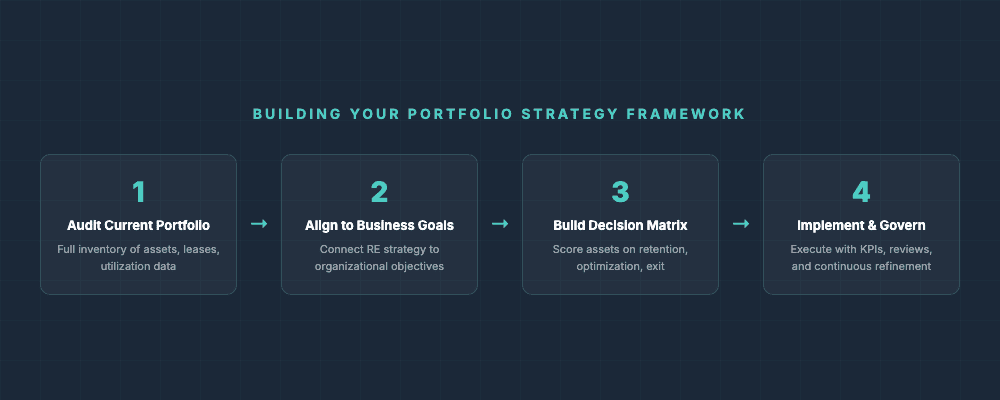
A portfolio strategy framework is a structured system for managing your organization’s real estate assets in deliberate alignment with broader business objectives. To build one that works, you need to complete ten sequential steps: audit your current portfolio, align with business objectives, define decision-making principles, segment your assets, build a space utilization strategy, integrate financial planning, incorporate flexibility, embed ESG commitments, leverage technology and data, and measure performance continuously. Organizations that follow this approach consistently reduce their total occupancy costs by fifteen to twenty-five percent while simultaneously improving workplace experience and strategic agility. This article covers each step in detail, with practical guidance drawn from real-world implementations at leading global organizations.
Corporate real estate is one of the most significant cost lines on any organization’s profit & loss statement. Yet despite the enormous financial stakes, a surprising number of organizations still manage their property portfolios reactively, making decisions based on short-term pressures, and fragmented data. The result is a portfolio that costs too much, delivers too little, and consistently fails to support the broader business strategy.
A well-constructed portfolio strategy framework gives organizations the clarity, structure, and decision-making rigor they need to transform their real estate from a passive cost center into a genuine strategic asset.
Why Most Portfolio Strategy Frameworks Fall Flat Before They Even Get Started
The Costly Mistakes Organizations Make When Skipping a Proper Framework
In my experience working and discussing with corporate real estate peers, the single biggest problem I see is that teams approach portfolio strategy piecemeal rather than thinking through the entire process holistically. They do certain components well and others not so well, never stepping back to see the complete picture. And compounding that is a lack of access to the right tools, the right framework, and the right guide on how to build it properly in the first place.
When organizations skip the framework-building process, they create a decision-making vacuum. Individual transactions get made in isolation, disconnected from broader organizational strategy. One business unit signs a ten-year lease in a city the company is quietly planning to exit. Another team fits out a premium office space just as the organization shifts to hybrid working. Without a framework to coordinate these decisions, the portfolio becomes an expensive monument to misalignment.
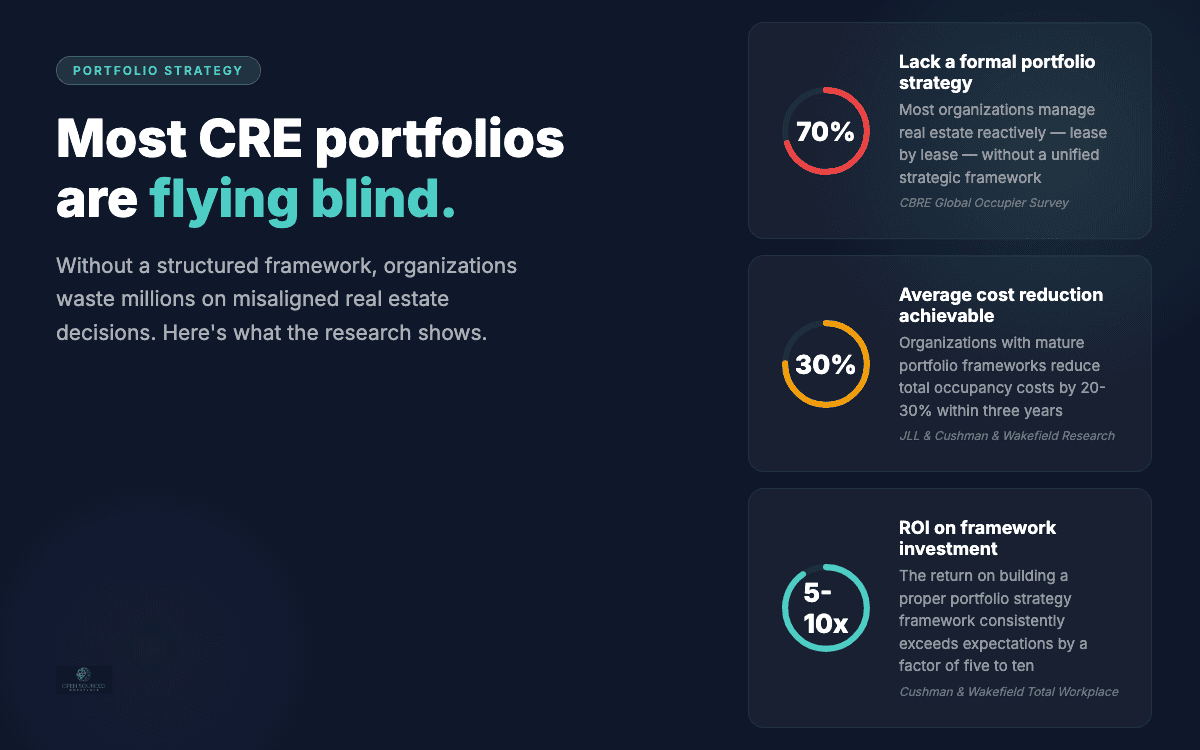
According to research published by CoreNet Global, organizations without a structured portfolio framework pay an estimated twenty to thirty percent more in total occupancy costs than those with mature, strategy-led real estate practices. The financial consequences of misalignment are severe and largely avoidable.
Why Good Intentions Are Not Enough Without a Structured Approach
Many organizations genuinely want to manage their real estate more strategically. The intention is there. What is missing is the architecture to translate that intention into consistent, disciplined action. Good intentions without structure produce sporadic improvement at best. They do not produce the kind of systematic, portfolio-wide transformation that delivers lasting results.
A structured approach creates repeatability. It ensures that the same analytical rigor applied to a major headquarters decision is also applied to a regional office renewal or a satellite location assessment. Structure is not bureaucracy. It is the scaffolding that allows smart people to make better decisions, faster, with greater confidence.
What a Portfolio Strategy Framework Actually Is and Why It Matters
Breaking Down the Core Components of a Winning Portfolio Framework
A portfolio strategy framework is a structured, integrated system for managing an organization’s real estate assets in deliberate alignment with its broader business objectives. It is not a spreadsheet. It is not a property database. And it is certainly not a one-time strategic review that gets filed away and forgotten.
At its core, a robust framework comprises several interconnected components: a comprehensive portfolio audit, a clear set of strategic principles and decision criteria, a financial model capturing the true cost of occupancy, a space utilization strategy informed by empirical data, a flexibility architecture anticipating future change, and a performance measurement system keeping the framework honest over time.
The RICS (Royal Institution of Chartered Surveyors) defines best-practice portfolio management as the integration of property decisions with corporate strategy through structured governance, rigorous financial analysis, and continuous performance measurement. This definition neatly captures the essence of what a well-designed framework must deliver.
How a Strong Framework Connects Real Estate Strategy to Business Goals
The most common failure mode in corporate real estate management is the disconnection between property decisions and business strategy. Real estate teams manage leases. Business leaders manage people and growth. And the two rarely speak the same language until a crisis forces the conversation.
A strong portfolio strategy framework dissolves that disconnection. It creates a direct, traceable line between every real estate decision and the organizational outcomes it is designed to support. When real estate strategy is genuinely integrated with business strategy, the entire portfolio becomes more purposeful, more defensible, and more valuable.
The Business Case for Building a Portfolio Strategy Framework Right Now
The macroeconomic environment has never made the case for portfolio discipline more compellingly. Organizations are navigating sustained cost pressures, hybrid working adoption, rapid technological change, and growing ESG obligations simultaneously. Each of these forces has profound implications for how and where organizations occupy space.
When you are making the business case to leadership for investing in a portfolio strategy framework, there are really four metrics that consistently resonate. First, cost avoidance — what decisions will this framework help us not make that would have cost us dearly? Second, cost savings — what are we currently spending that a better framework would eliminate? Third, employee engagement — what impact will this have on our engagement scores and our ability to attract and retain talent? And fourth, risk mitigation — are our people safe, are we close to our customers, is the commute and transportation situation working for our workforce? Get fluent in those four metrics and the executive conversation becomes significantly easier.
JLL’s Global Real Estate Outlook consistently finds that organizations with mature portfolio strategies outperform their peers on exactly these dimensions — cost efficiency, space utilization, and employee experience ratings.
How Top Organizations Are Using Frameworks to Cut Costs and Drive Growth
The most sophisticated corporate real estate teams in the world are using portfolio strategy frameworks not just to reduce costs but to actively create value. They use utilization data to renegotiate leases from a position of strength. They use location analytics to identify talent-rich markets before their competitors do. They use scenario modeling to evaluate the financial implications of portfolio decisions before committing a single dollar of capital.
In large portfolios, the financial impact runs into tens of millions of dollars annually. These are not marginal gains. They are transformative results that come directly from the disciplined application of a robust strategic framework.
The Competitive Advantage You Are Missing Without a Clear Portfolio Strategy
Real estate is a strategic weapon that most organizations are leaving holstered. A well-managed portfolio can accelerate talent acquisition by positioning offices in the right markets. It can enhance brand perception through thoughtfully designed flagship workplaces. It can reduce operational risk through diversified geographic footprints. And it can free up significant capital for reinvestment in core business activities.
Step One: Auditing Your Current Portfolio Before You Build Anything
How to Take a Full Inventory of Your Existing Real Estate Assets
Before you can build a framework, you need to know exactly what you have. This sounds obvious. But let me be direct about something that often gets glossed over: this step is genuinely hard, and the difficulty is almost always underestimated.
Most organizations do not have sophisticated systems with all this information in one place. What they typically have is data spread across multiple databases and multiple systems — lease information in one place, headcount data in another, cost data somewhere else entirely, and utilization numbers, if they exist at all, in yet another system. The actual grind of getting everything into one place so that a framework can be built and models can be constructed on top of it — that is the challenge that is most frequently overlooked. And the time required to pull it all together is almost always understated.
A comprehensive portfolio audit covers every asset in the estate, regardless of tenure type, size, or geography. Owned properties, leased properties, subleased spaces, shared facilities, and even informal workspace arrangements all need to be captured. For each asset, document the fundamental parameters including location, size, lease expiry or ownership tenure, current occupancy, annual cost, and physical condition.
Identifying Underperforming Assets That Are Draining Your Budget
Once you have a complete inventory, the next task is interrogation. A rigorous audit will almost always surface a cohort of properties consuming disproportionate resources relative to the value they deliver. Underperforming assets manifest in several ways: chronic underutilization, over-specification, location misalignment, or simply legacy lease structures that predate the current market reality.
Research from CBRE’s Occupier Sentiment Survey consistently finds that organizations hold between twenty and thirty percent more space than they actually need, with significant variation by sector and geography. Identifying this surplus is the essential first step toward portfolio optimization.
The Data You Need to Collect Before You Can Build a Meaningful Framework
The audit should yield a rich, multidimensional dataset covering financial, operational, physical, and strategic dimensions for each asset. On the financial side, you need total cost of occupancy data. On the operational side, you need utilization rates and headcount data. On the physical side, you need condition assessments. And on the strategic side, you need a clear view of how each asset maps to current and anticipated business requirements.
Do not rush this phase. The temptation to move quickly to the more exciting parts of framework development is understandable, but the quality of everything that follows is entirely dependent on the quality of this foundational data work. Take the time to do it properly.
Step Two: Aligning Your Portfolio Strategy With Your Business Objectives
Why Your Real Estate Strategy Must Follow Your Business Strategy and Not the Other Way Around
This is perhaps the most important principle in the entire framework. Real estate strategy is a derivative of business strategy. It exists to enable organizational objectives, not to pursue property goals in isolation. When the sequence is inverted and real estate decisions drive business decisions rather than the other way around, the organization becomes constrained by its own property obligations.
Here is where things start to get genuinely exciting, though. Once the data foundation is solid — once you have done the hard work of pulling everything together into a clean, consolidated, accurate single source of truth — something changes. You are no longer guessing. You are no longer defensive in conversations with leadership. You have the confidence that comes from knowing your information is right, and that changes everything about how you show up in those conversations.
Clean, consolidated data gives you the currency to communicate effectively upward to executives, across to other departments like Finance and HR, and outward to the consultants and third parties you may be working with. That sense of empowerment that comes from knowing your data is accurate is not just psychological — it has real, tangible business consequences in terms of the quality of the decisions that get made and the speed at which they get made.
How to Get Leadership Buy-In Before You Start Building Your Framework
Getting executive buy-in is one of the most consistently underestimated challenges in portfolio strategy framework development. And frankly, a lot of the difficulty comes from not being able to articulate the ROI and the risk mitigations that a framework like this delivers clearly and compellingly.
The key is to speak the language of the executives you are trying to persuade. Lead with cost avoidance and cost savings — those are always going to be at the top of the list when it comes to real estate conversations. Follow with the employee experience angle: what impact will this have on attracting and retaining talent, engagement scores – on the annual reviews and quarterly surveys that leadership already cares deeply about? And then close with risk mitigation. CIPD’s research on strategic HR and facilities alignment highlights that cross-functional executive sponsorship is the single most important predictor of successful workplace transformation initiatives.
Setting Clear Goals That Connect Portfolio Performance to Organizational Outcomes
Your portfolio strategy framework needs clear, measurable goals expressed in the language of business outcomes, not just real estate metrics. Reducing the portfolio cost per square foot by fifteen percent is a real estate goal. Releasing twenty million dollars of annual operating cost to fund product development is a business outcome. Goals should be specific, time-bound, and genuinely stretching.
Step Three: Defining Your Portfolio Principles and Decision-Making Criteria
How to Establish the Core Principles That Will Guide Every Portfolio Decision
Portfolio principles are the standing rules that govern how your organization approaches real estate decisions. They are strategic commitments that reflect the organization’s values, priorities, and risk appetite as they relate to its office portfolio. Examples might include a preference for lease flexibility over long-term commitment in uncertain markets, or a commitment to sustainability standards that exceed regulatory minimums.
Building a Decision-Making Matrix That Removes Emotion From the Equation
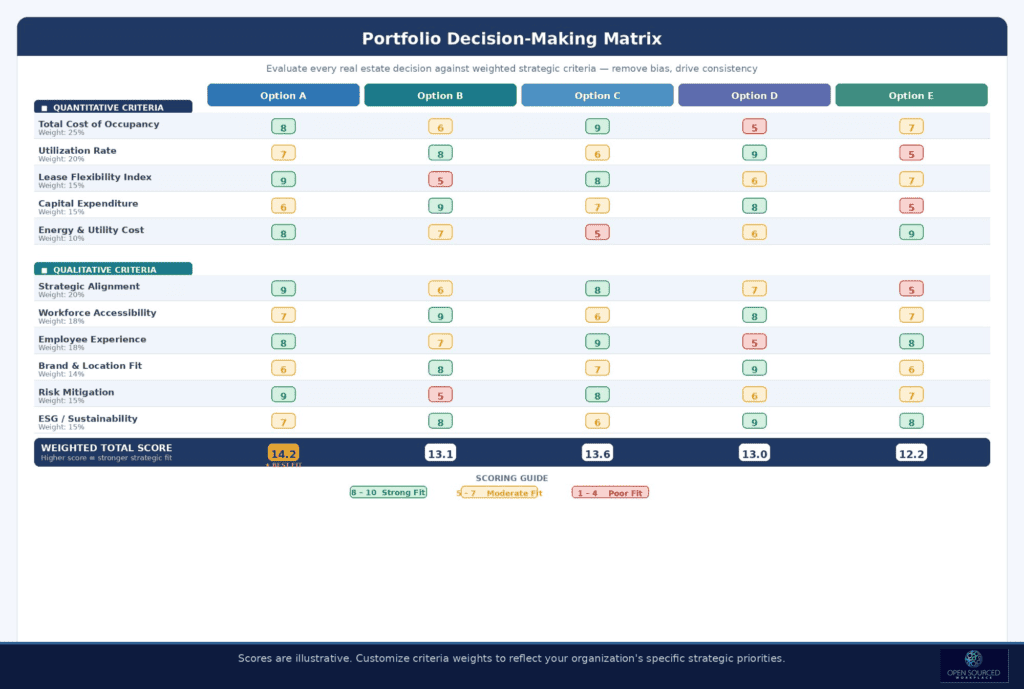
Even the most experienced real estate professionals are susceptible to cognitive bias. A decision-making matrix provides a structured antidote by defining the criteria against which every significant portfolio decision will be evaluated, weighted according to strategic importance. The matrix should include both quantitative criteria such as total cost of occupancy and utilization rates, and qualitative criteria such as strategic alignment and workforce accessibility.
Why Consistency in Decision Criteria Is the Secret to Long-Term Portfolio Success
Consistency is the property of a framework that compounds over time. Each decision made through a consistent, principled process adds to an accumulating body of institutional knowledge and strategic coherence. Protect your decision criteria. Review them periodically to ensure they remain strategically current. But resist the temptation to make exceptions. Exceptions are where frameworks go to die.
Step Four: Segmenting Your Portfolio for Smarter Management
How to Categorize Your Real Estate Assets by Risk, Value, and Strategic Importance
Portfolio segmentation is the discipline of categorizing your assets in ways that allow you to allocate resources, attention, and investment with greater precision. A robust segmentation model typically operates across three primary dimensions: strategic importance, financial materiality, and risk profile. By mapping your portfolio across these three dimensions simultaneously, you create a nuanced picture of where your assets sit relative to each other and relative to the overall portfolio strategy.
The Power of Portfolio Segmentation in Driving Targeted Investment Decisions
Segmentation transforms the way you make investment decisions. Core strategic assets warrant premium investment in workplace quality and technology infrastructure. Transactional assets should be managed with ruthless cost discipline. This targeted approach ensures that every dollar of real estate investment works as hard as possible in service of organizational outcomes.
Using Segmentation to Prioritize Resources Where They Matter Most
Beyond investment, segmentation also informs how you allocate management time, technical expertise, and strategic attention. Assets in the core strategic segment require proactive, relationship-intensive management. Assets in the transactional segment can often be managed more efficiently through standardized processes and outsourced delivery models.
Step Five: Building Your Workplace and Space Utilization Strategy
Why Space Utilization Data Is the Foundation of a Smart Portfolio Framework
You cannot manage what you do not measure. For decades, organizations made real estate decisions based on headcount projections and planning standards, estimating how much space they needed without systematically measuring how much space they were actually using. The results were predictably wasteful.
Studies conducted by Leesman, the global workplace experience measurement firm, consistently find that offices are occupied at between forty and sixty percent of their theoretical capacity on average. This data represents an enormous opportunity for organizations willing to act on it.
How to Use Occupancy Analytics to Right-Size Your Real Estate Footprint
Occupancy analytics involves the systematic collection and analysis of space utilization data to identify opportunities for portfolio optimization. Modern sensor technologies make it possible to capture this data continuously and at high resolution. The analytical output typically includes peak utilization rates, average daily occupancy levels, utilization heat maps by zone and floor, and trend data showing how patterns change over time.
Balancing Flexibility and Efficiency in Your Workplace Strategy
The tension between flexibility and efficiency is one of the defining challenges of contemporary workplace strategy. The most effective workplace strategies navigate this tension thoughtfully, creating portfolios of space types that provide genuine choice and variety while still achieving meaningful efficiency targets. Getting this balance right requires both data and genuine empathy with the people who use the space every day.
Step Six: Integrating Financial Planning Into Your Portfolio Framework
How to Build a Total Cost of Occupancy Model That Reveals the True Cost of Your Portfolio
The total cost of occupancy is the complete financial cost of holding and operating a real estate asset, encompassing every cost element from base rent and service charges through to utilities, cleaning, security, maintenance, fit-out depreciation, and technology infrastructure. Building a robust model requires the integration of data from multiple functions including finance, facilities management, IT, and HR.
The CoreNet Global benchmarking database provides sector-specific total cost of occupancy benchmarks (membership required to access) that allow organizations to compare their performance against industry peers and identify the specific cost components that represent the greatest optimization opportunity.
Connecting Capital Planning to Portfolio Strategy for Smarter Long-Term Investment
Capital planning and portfolio strategy need to be synchronized to avoid the misallocation of investment that occurs when major fit-out decisions are made without reference to the long-term trajectory of the portfolio. Investing heavily in a location that the portfolio strategy identifies as a future exit is not just wasteful. It creates a sunk cost that complicates future decision-making.
Using Financial Scenario Modeling to Stress-Test Your Portfolio Decisions
Financial scenario modeling addresses portfolio uncertainty by testing decisions against a range of alternative future conditions including economic downturns, market rent corrections, headcount fluctuations, and changes in working patterns. This kind of disciplined uncertainty analysis is what separates genuinely strategic portfolio management from sophisticated guesswork.
Step Seven: Incorporating Flexibility and Future-Proofing Into Your Framework
Why the Best Portfolio Frameworks Are Built to Adapt and Not Just to Last
Durability and adaptability are not the same thing. A framework built to adapt maintains its structural integrity while continuously incorporating new data, updating its strategic assumptions, and reconfiguring its component parts in response to changing conditions. The best frameworks have review cycles baked in, governance structures that allow for rapid recalibration, and a culture of strategic honesty.
Here is the insight that I believe matters most when we talk about future-proofing: time is the enemy of a bad real estate result. The more time and flexibility an organization has when it comes to making real estate decisions, the better the outcome is always going to be. A framework gives you that time. It gives you the forward visibility — typically eighteen months, two years, even three years out — to plan proactively rather than react to circumstances. And that planning horizon is worth more than almost any other single advantage in the corporate real estate space.
How to Build Flexibility Levers Into Your Real Estate Portfolio Strategy
Flexibility levers are the structural mechanisms through which a portfolio can adapt to change without incurring prohibitive cost or disruption. They include lease break options, short-term lease structures in uncertain markets, flex space allocations that can absorb demand fluctuations, and modular fit-out standards that allow spaces to be reconfigured as requirements evolve.
Having a framework in place allows you to have conversations with executives on a much longer time frame. You move from reactive to proactive. You are able to source and procure the best real estate for the organization at the right time, rather than scrambling for whatever is available when a lease expires with six months’ notice.
Preparing Your Portfolio for Hybrid Work, Market Shifts, and Business Disruption
The hybrid working revolution has permanently altered the demand profile for corporate real estate. Organizations are discovering that their pre-pandemic portfolios, designed around the assumption of near-universal daily attendance, are profoundly misaligned with post-pandemic working patterns. A portfolio strategy framework that genuinely accounts for hybrid work needs to address not just the quantum of space required but its typology, configuration, and geographic distribution.
Gartner’s research on hybrid workplace strategy identifies flexibility, intentional design, and performance-focused culture as the three defining characteristics of organizations that successfully navigate the transition to hybrid working.
Step Eight: Embedding Sustainability and ESG Into Your Portfolio Strategy
Why ESG Is No Longer Optional in a High-Performing Portfolio Strategy Framework
Environmental, Social, and Governance considerations have moved from the periphery to the center of corporate real estate strategy with remarkable speed. What was once a reputational nicety has become a regulatory obligation, a financial imperative, and a talent retention necessity. Organizations that continue to treat ESG as optional are not just taking an ethical risk. They are taking a commercial one.
The GRESB Real Estate Assessment has become the de facto global standard for measuring, benchmarking, and reporting on the ESG performance of real estate portfolios. Organizations participating in GRESB assessments consistently demonstrate better access to capital, lower occupancy costs, and stronger stakeholder relationships than non-participants.
How Leading Organizations Are Integrating Net Zero Goals Into Their Real Estate Frameworks
The most progressive organizations are approaching net zero not as a compliance exercise but as a portfolio transformation opportunity. They use their net zero commitments as a catalyst for systematic asset quality improvement, accelerating the exit from energy-inefficient properties, investing in building upgrades that deliver long-term operational cost savings, and building renewable energy procurement into their utility strategies.
The World Green Building Council’s Net Zero Carbon Buildings Commitment provides a globally recognized framework for organizations committing to net zero operational carbon in their real estate portfolios by 2030, with whole life carbon addressed by 2050.
Practical Steps to Align Your Portfolio With Sustainability Targets and Reporting Standards
Alignment between portfolio strategy and sustainability targets begins with measurement. Organizations need a reliable baseline of their current carbon emissions, energy consumption, water usage, and waste generation across the entire property estate. From that baseline, develop an asset-level improvement roadmap that sequences investments in building upgrades, technology installations, and lease transitions to deliver the greatest carbon reduction impact at the most efficient cost.
Step Nine: Leveraging Technology and Data to Power Your Framework
The PropTech Tools That Are Transforming How Organizations Manage Their Portfolios
The PropTech revolution has produced a generation of technology tools giving corporate real estate teams unprecedented analytical capability. Integrated workplace management systems provide a single platform for managing lease administration, space planning, facilities management, and capital projects. Occupancy sensors generate the utilization data that right-sizing decisions depend on. Digital twin platforms create virtual replicas of physical buildings enabling scenario modeling at previously impossible fidelity.
Gartner’s Market Guide for Integrated Workplace Management Systems provides comprehensive guidance on evaluating and selecting the right IWMS platform for your organization’s specific requirements and maturity level.
How Real Estate Analytics Platforms Turn Raw Data Into Actionable Portfolio Insights
Data without analysis is just noise. The value of a real estate analytics platform lies not in the volume of data it captures but, in its ability, to transform that data into clear, actionable insights that improve decision-making. The most powerful platforms combine internal portfolio data with external market intelligence to create a comprehensive view of portfolio performance in its broader competitive and economic context.
Building a Data Governance Model That Keeps Your Portfolio Intelligence Accurate and Reliable
The quality of your portfolio decisions is directly proportional to the quality of your portfolio data. A data governance model is the set of policies, processes, and accountabilities that ensure your portfolio data remains accurate, consistent, and current over time. Data governance is unglamorous work, but it is the invisible infrastructure that makes everything else in your framework possible.
Step Ten: Measuring Performance and Keeping Your Framework Alive
The Key Performance Indicators Every Portfolio Strategy Framework Must Track
A portfolio strategy framework without measurement is a strategy without accountability. Effective KPIs span multiple dimensions: financial KPIs such as total cost of occupancy per square foot and cost per workstation; operational KPIs such as space utilization rates and facilities management response times; and strategic KPIs such as portfolio alignment score and sustainability certification coverage.
The IFMA (International Facility Management Association) publishes annual benchmarking data across all major real estate KPI categories, providing organizations with the external reference points they need to contextualize their own performance.
How to Build a Portfolio Dashboard That Keeps Leadership Informed and Engaged
A portfolio dashboard is the primary communication tool through which the CRE function maintains leadership visibility and engagement. It needs to be designed with the audience in mind, presenting the most strategically relevant information in the clearest possible format. The best dashboards tell a story. They do not just present data. They contextualize it, highlight anomalies, flag emerging risks, and surface the decisions that require leadership attention.
Why Regular Portfolio Reviews Are the Secret to Staying Ahead of the Market
A portfolio strategy framework is not a static document. It is a living management system that needs regular review and recalibration to remain strategically relevant. At a minimum, most organizations benefit from a quarterly operational review, an annual strategic review, and a triennial comprehensive audit. These reviews are the moments at which the framework demonstrates its value most visibly, translating continuous data collection into strategic insight and decisive action.
Common Pitfalls to Avoid When Implementing Your Portfolio Strategy Framework
Why Overcomplicating Your Framework Is the Fastest Way to Kill Adoption
There is an ironic tendency in the development of strategic frameworks to over-engineer them into instruments of such complexity that they become unusable in practice. The most effective portfolio strategy frameworks distill genuinely complex analytical and strategic content into clear, actionable guidance. Resist the temptation to add more dimensions, more criteria, and more metrics than are genuinely necessary.
How to Avoid the Trap of Building a Framework That Sits on a Shelf and Collects Dust
The graveyard of corporate strategy is full of beautifully crafted frameworks that were launched with great fanfare and abandoned within eighteen months. Frameworks survive and thrive when they are embedded in operational processes, not when they exist as separate strategic documents. Integrate framework principles into lease approval processes, capital investment decisions, and vendor selection criteria.
The Stakeholder Management Mistakes That Derail Even the Best Portfolio Strategies
Even technically excellent frameworks fail when they lack genuine stakeholder support. The most common mistakes include underestimating the concerns of business unit leaders whose operational autonomy is perceived to be threatened by centralized portfolio governance and treating stakeholder engagement as a one-time event rather than an ongoing relationship management discipline.
Prosci’s research on change management best practices consistently identifies active and visible executive sponsorship as the number one contributor to successful organizational change initiatives, including portfolio strategy transformations.
Real World Examples That Demonstrate What Is Possible
CBRE and a Regional Financial Services Firm
CBRE’s portfolio strategy practice documented a case in which they helped a regional financial services firm unify its retail and real estate strategy using predictive analytics, resulting in millions of dollars in capital gains and cost savings. The approach involved consolidating fragmented portfolio data, applying a consistent framework for evaluating asset performance, and using data-driven insights to rationalize locations and renegotiate lease terms from a position of analytical strength.
The Competitive Gap Is Substantial and Growing
CoreNet Global’s research consistently shows that companies with well-defined corporate real estate strategies achieve 15 to 20 percent lower occupancy costs compared to those managing real estate reactively. In a portfolio of significant scale, that difference runs into tens of millions of dollars annually. That is not a marginal efficiency gain. That is a structural competitive advantage — and it compounds over time.
The Hybrid Work Challenge as a Framework Test
JLL’s 2024 Future of Work Survey found that 85 percent of organizations now have a policy requiring at least three days of office attendance per week. Yet office utilization rates remain significantly below organizational targets. The organizations navigating this tension most effectively are those with frameworks that allow them to model the space implications of different attendance scenarios and make evidence-based portfolio decisions — rather than reacting to each quarter’s attendance data with ad hoc adjustments.
How to Get Started on Your Portfolio Strategy Framework This Week
The Quick Wins You Can Achieve in the First 30 Days of Building Your Framework
The first thirty days should be focused on two things: building the evidential foundation and generating momentum. And let me be honest with you — those first thirty days are going to be less glamorous than you might hope. The primary task is data consolidation, and that means rolling up your sleeves and getting information out of the multiple databases and systems it currently lives in and into a single, coherent source of truth.
That work is hard. It takes longer than people expect. But it is the only foundation on which a genuinely effective framework can be built. Do not shortcut it. At the same time, initiate the portfolio audit, begin assembling total cost of occupancy data, and secure the senior sponsorship that will give the initiative organizational legitimacy.
Building Your Internal Team and Identifying the Right External Partners to Support You
A portfolio strategy framework initiative requires a capable internal team with a clear mandate and adequate resources. The core team should include a senior CRE professional with strategic credibility, a financial analyst with real estate modeling capability, a data analyst experienced in occupancy analytics, and a project manager with strong organizational skills. Supplement this team selectively with external partners who can fill specific capability gaps in workplace strategy, market intelligence, or technology implementation.
Your Step by Step Action Plan to Launch a Portfolio Strategy Framework That Actually Works
The path from intention to a fully operational portfolio strategy framework is navigable for any organization that approaches it with discipline, patience, and genuine strategic commitment. Begin with the audit. Get the data right. Align with business strategy before you build anything. Define your principles clearly. Segment your portfolio thoughtfully. Build the financial models that give your decisions analytical rigor. Embed flexibility as a design principle. Take ESG seriously. Use technology intelligently. Measure relentlessly.
And remember the single most important truth about portfolio strategy: time is your most valuable asset. The organizations that invest in building robust frameworks are the ones that earn the planning horizon — eighteen months, two years, three years out — that allows them to source and procure the right real estate at the right time, in the right locations, at the right cost. That is not just good real estate management. That is competitive advantage.
The opportunity is there. The methodology is proven. The only question is whether your organization is ready to seize it.
Related Questions
1. What Is the Difference Between a Portfolio Strategy Framework and a Workplace Strategy?
These two terms are often used interchangeably but they refer to distinct, complementary disciplines. A portfolio strategy framework is the overarching management system that governs how an organization manages its entire real estate, including financial planning, asset segmentation, lease management, risk governance, and performance measurement. It operates at the portfolio level, addressing questions about which assets to hold, where to locate them, and how to optimize their collective financial performance.
A workplace strategy, by contrast, is specifically concerned with how physical space is designed and configured to support the way people work. It addresses questions about space typology, density, amenity provision, technology integration, and employee experience. Workplace strategy is an important component within a broader portfolio strategy framework, but it represents only one of the many disciplines that a comprehensive framework must encompass. The most sophisticated organizations develop both in tandem, ensuring that workplace design decisions are made within a framework that also addresses the financial, contractual, and strategic dimensions of the real estate portfolio.
2. How Long Does It Take to Build and Implement a Portfolio Strategy Framework?
The honest answer is that it takes longer than most organizations expect — and the primary reason for that is the data consolidation challenge. For a mid-sized organization with a portfolio of between twenty and fifty properties, the initial framework development phase typically takes between three and six months. But that timeline assumes the data foundation work has already been done, and in most organizations, it has not.
The subsequent implementation phase, during which the framework becomes embedded in operational processes and begins to generate measurable performance improvements, typically takes a further twelve to eighteen months. Full maturity is generally achieved within two to three years of the initial launch. Organizations that invest in robust data infrastructure and change management support from the outset consistently achieve maturity faster than those that treat these as secondary considerations.
For more guidance on implementation timelines and organizational readiness assessment, Cushman & Wakefield’s Total Workplace research provides practical benchmarks and case studies from organizations at various stages of framework maturity.
3. How Do You Measure the Return on Investment of a Portfolio Strategy Framework?
Measuring the return on investment of a portfolio strategy framework requires a baseline assessment conducted before the framework is implemented and a systematic tracking of key performance indicators over time. The most direct financial returns typically manifest in four areas: reduction in total cost of occupancy, recovery of value from underutilized assets, avoidance of capital expenditure through better space planning, and improvement in lease terms achieved through more disciplined transaction management.
Beyond direct financial returns, a mature portfolio strategy framework also delivers significant indirect value through improvements in employee engagement, enhanced organizational agility, stronger ESG performance, and reduced operational risk. Organizations that invest in measuring both the direct and indirect returns from their portfolio strategy frameworks consistently find that the total return on investment substantially exceeds initial expectations, often by a factor of five to ten times the cost of framework development and implementation.
Build Your Portfolio Strategy Faster With AI
The Workplace AI Prompt Library includes dedicated CRE and portfolio strategy prompts — grounded in frameworks from CBRE, JLL, Cushman & Wakefield, and IFMA. Every prompt uses the Role-Context-Format method to deliver expert-level analysis in minutes instead of hours.
Download the free 25-prompt sampler to test the framework with your own portfolio data. Or explore the full 520+ prompt library for comprehensive CRE, FM, and workplace strategy coverage.
Recent Posts
The Science-Backed Connection Every Leader Needs to Understand The most direct lever for improving employee performance is not better processes or tighter metrics — it is trust. Neuroscientist...
Nobody Told Us AI Would Make Us Feel Like We're Bad at Our Jobs
Why AI gives HR professionals generic outputs — and why it was never your fault. If you're an HR professional finding that AI outputs feel generic, shallow, or unusable for real HR work — the...