

I’ll be honest with you. I never thought about this until recently.
I was building out some content for the site, and I started researching what people type into Google when they’re confused about HR terminology. The search data surprised me. Thousands of people every month are genuinely unsure whether it’s “Human Resource” or “Human Resources” — and not just beginners. Experienced professionals, people writing job postings, policy documents, LinkedIn headlines.
That got me curious. So, I went looking for the answer.
Quick Answer: Use “Human Resources” (plural) as your default for department names, job titles, and any standalone reference to the function. “Human Resource” (singular) is only correct when it acts as an adjective in front of another noun — as in “human resource management” or “human resource planning.” If you’re in doubt, go plural. It’s almost never wrong.
What I found was more interesting than I expected — because the grammar question turned out to be almost the least interesting part.
Why People Are Confused (And You’re Not Alone)
Here’s the thing about confusion: it usually has a reason. People don’t randomly stumble on questions like this. When thousands of professionals are searching for the same phrase, something genuinely unclear is happening in the world they’re working in.
And in this case, the confusion is real. If you work in or around HR, you’ve almost certainly seen both versions used — sometimes in the same organization, sometimes by the same person. Human Resource Manager. Human Resources Department. Human Resource Management. Human Resources Business Partner.
Which one is right? The answer depends on what you’re doing with the words. Let me explain.
The Grammar: One Simple Rule
When you use “human resource” as an adjective — meaning it’s describing something else — you drop the S.
Human resource management. Human resource planning. Human resource strategy.
In these cases, “human resource” is functioning like a modifier. The same way you say “project management” and not “projects management.” The noun being described is the thing that follows.
When you’re talking about the department, the field, or the people in it as a standalone noun — you use the plural.
Human Resources is responsible for onboarding. I work in Human Resources. The Human Resources team has grown this year.
That’s it. That’s the grammar rule. Adjective: no S. Noun: S.
The reason this trips people up is that both forms get used in formal titles, and organizations aren’t consistent about which convention they follow. You’ll see “VP of Human Resource” and “VP of Human Resources” at different companies — both considered acceptable depending on house style.
But Then Something Else Happened
Once I understood the grammar, I thought that was the end of the story. It isn’t.
Because while I was researching, I kept bumping into a different question entirely. Not “Human Resource” versus “Human Resources” — but why so many organizations have stopped using either term at all.
“People Team.” “People Operations.” “People and Culture.” “Talent.” “Employee Experience.”
These names are everywhere now, especially in tech. And the more I read about where they came from, the more I realized this wasn’t just a trend. It was a deliberate signal — one that started in Silicon Valley and spread.
Where “People Operations” Actually Came From
Google is usually credited with popularizing the “People Operations” name, and the story behind it matters. Larry Page and Sergey Brin didn’t want a traditional HR function. They wanted a team that treated people decisions the way engineers treat product problems — with data, experimentation, and a genuine belief that understanding what makes employees effective is a competitive advantage.
The name “People Operations” was a signal. It told employees: this department isn’t here to process paperwork and enforce policy. It’s here to make this organization work better by making people’s experience better.
Facebook, Uber, Airbnb, and dozens of other tech companies followed. The name spread.
I remember reading about this — stories of how Google employees would put problems on whiteboards on a Friday, and by Monday the community had solved them. Products emerging from that culture. The name “People Operations” wasn’t decoration. It reflected something that was happening: a company that genuinely ran on its people’s ideas and trusted them to contribute.
That’s what made the name change meaningful. Not the words themselves.
I Thought It Was a Marketing Ploy
Here’s where I must be honest about my own experience.
I’ve experienced this kind of rebrand. The announcement came — the HR function was being renamed. Something more people centered. More modern.
My reaction? Skepticism.
I thought it was an internal marketing exercise. A way to make an administrative function sound more strategic without changing anything.
But something different happened over time. New functions started appearing. Employee experience work that hadn’t existed before. People analytics. A genuine shift in how the department engaged with the business. The name had arrived before the substance — but the substance did arrive.
It happened gradually. New hire by new hire. Person by person. There was no single moment where everything changed. Looking back, I think the name and the change were happening simultaneously — each one feeding the other.
It’s not the name change that makes the difference. It’s the people change — the mentality, the relationship between the function and the strategic alignment with the rest of the organization.
What ‘Strategic Alignment’ Means
When HR professionals talk about strategic alignment, they mean something specific — and it’s worth unpacking because it explains the naming shift better than any grammar lesson could.
Traditional HR, at its core, manages compliance and administrative process. Recruitment logistics, payroll, benefits, disciplinary procedures. These are important. But they’re fundamentally reactive — the business sets its direction, and HR supports it.
Strategic HR is different. The people function is involved in forward planning: What skills will this organization need in three years? How do we build those capabilities now? What does our talent pipeline look like relative to where the business is going? How do we measure the relationship between people investment and organizational outcomes?
When you see those functions operating seriously — workforce planning, people analytics, meaningful employee experience design, genuine strategic input — the name “People Operations” tends to fit. When those functions are aspirational or absent, the traditional name fits better, even if nobody will say so out loud.
The Honest Truth About What the Name Actually Signals
Here’s what I took from all of this, and I think it matters for how you use these terms:
The name doesn’t create the change. But the name does reflect what an organization is trying to become — or what it believes about itself.
When a company says, “Human Resources,” it’s using language that treats the workforce as an asset class. That’s not inherently wrong — it’s accurate, in a certain frame. People are a resource. Organizations allocate them, develop them, deploy them.
When a company says, “People Team” or “People Operations,” it’s making a different claim. It’s saying: we see the humans first, not the resource. Whether that claim is true depends entirely on what the department does.
Both terms can coexist with an excellent or a terrible HR function. The name is a signal of intent. The function is the reality.
SHRM — the Society for Human Resource Management, arguably the most established professional body in the field — still uses “Human Resource Management” in its official name. That tells you something too. The formal, credentialed world of HR hasn’t abandoned the traditional terminology. It coexists with the newer language.
How to Choose the Right Term for Your Context
So back to the original question: Human Resource or Human Resources? Here’s a practical framework.
Use “Human Resource” (no S) when:
- You’re using it as an adjective before another noun — Human Resource Management, Human Resource Planning, Human Resource Development
- You’re writing in an academic or formal policy context where this construction is standard
- The style guide of your organization specifies it
Use “Human Resources” (with S) when:
- You’re referring to the department or field as a standalone noun — “I work in Human Resources”
- You’re writing a job title or department name, and your organization uses this convention — Human Resources Manager, VP of Human Resources
- You’re not sure, and you want the safer default — “Human Resources” is more universally recognized
Consider alternatives when:
- Your organization has already adopted “People Team,” “People Operations,” or similar — use whatever your internal standard is
- You’re writing for a tech or startup audience where “People” naming is now common
- The context calls for a more human-centered framing
What This Small Detail Actually Reveals
I started this with a grammar question. But the more I looked at it, the more I realized the question behind the question is bigger.
How organizations talk about their HR function tells you something about how they think about their people. Not everything — language can be performative, and plenty of “People Teams” are just traditional HR with a fresh coat of paint. But the language is a window.
If you’re a professional writing about HR, getting the grammar right is the floor. Understanding what the naming signals — and what it doesn’t guarantee — is the ceiling.
Any confusion you started with makes sense. The answer isn’t just a grammar rule. It’s a whole conversation about what we think people at work actually are.
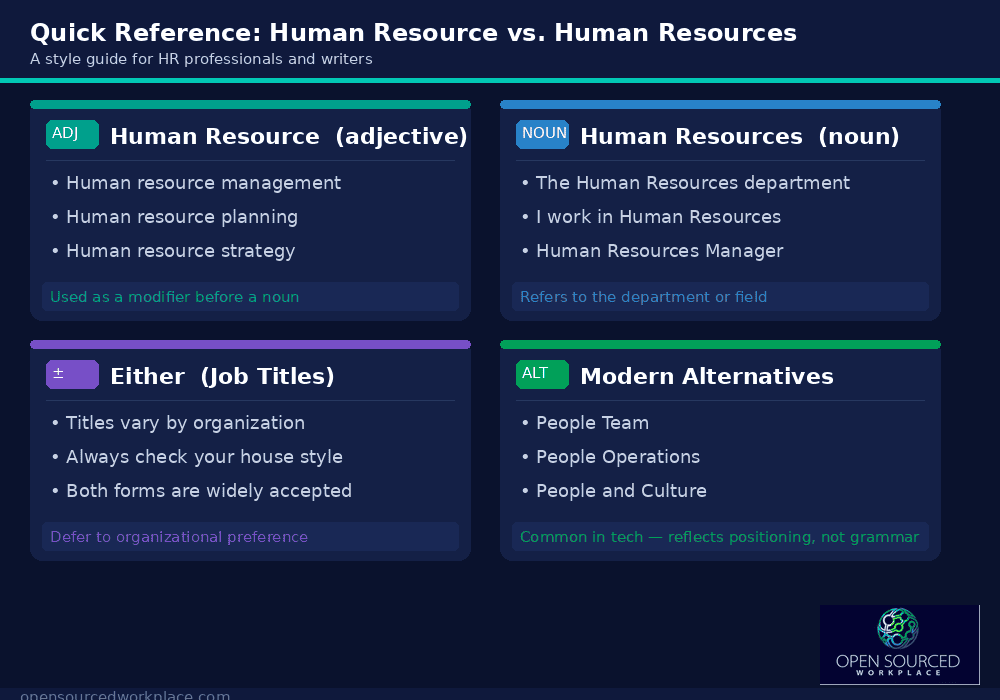
Quick Reference: Human Resource vs. Human Resources
- Human resource (adjective): Human resource management, human resource planning, human resource strategy
- Human Resources (noun): The Human Resources department, I work in Human Resources, Human Resources Manager
- Either: Job titles vary by organization — check the house style
- Alternatives: People Team, People Operations, People and Culture — common in tech; reflect organizational positioning, not grammar
Related Questions
Is “Human Resource Management” or “Human Resources Management” correct?
Both are used in academic and professional contexts. “Human Resource Management” (singular modifier) is extremely common in university course titles and journal names. “Human Resources Management” appears frequently in organizational contexts. Neither is wrong.
Why do some companies use “People & Culture” instead of HR?
It’s the same strategic signal described above — with added emphasis on organizational culture as a strategic lever rather than an HR outcome. Culture has become a visible differentiator in talent markets, which is why forward-looking organizations name it explicitly.
Does the job title matter — “Human Resource Manager” or “Human Resources Manager”?
Both are widely used. Check the specific organization’s standard. “Human Resources Manager” is slightly more common in North America, but both are professionally recognized.
Sources and Further Reading
The following sources informed this article:
- SHRM — Society for Human Resource Management

- SHRM Body of Applied Skills and Knowledge (BASK)
- CIPD — Chartered Institute of Personnel and Development
- Dave Ulrich on HR transformation — University of Michigan Ross
- Google re:Work — People Operations
- International Journal of Human Resource Management
- Merriam-Webster: human resources
- Josh Bersin — HR and talent research
- Netflix Culture Memo
Recent Posts
The Science-Backed Connection Every Leader Needs to Understand The most direct lever for improving employee performance is not better processes or tighter metrics — it is trust. Neuroscientist...
Nobody Told Us AI Would Make Us Feel Like We're Bad at Our Jobs
Why AI gives HR professionals generic outputs — and why it was never your fault. If you're an HR professional finding that AI outputs feel generic, shallow, or unusable for real HR work — the...