
The Science-Backed Connection Every Leader Needs to Understand
The most direct lever for improving employee performance is not better processes or tighter metrics — it is trust. Neuroscientist Paul Zak’s research shows employees in high-trust organizations are 50% more productive and 76% more engaged than those in low-trust environments. The mechanism is neurological: trust reduces threat responses, enabling the focus, creativity, and risk-taking that performance requires. Competence determines the ceiling. Trust determines whether people reach it.
I have been fortunate. Over a career spanning finance and corporate real estate, I found myself in teams where I felt genuinely safe — not in a vague, cultural-values-poster sense, but in the practical sense that mattered most: I could raise hard topics without hesitation, push back without consequences, and contribute to decisions that were ultimately not mine to make. The leader set that framework deliberately. Everyone had a voice. And when the decision came, we committed to it and executed — no residual politics, no quiet dissent.
What I remember most is what happened when I was quiet in a meeting. Rather than letting that silence sit, the leader would call me afterward. Not to question me, but to check in — how did you feel the meeting went, what are your thoughts, are we on the right path? That call did something specific: it showed me that my thinking mattered even when I was not the most vocal person in the room. The result was that I started communicating more, not less — weekend thoughts, things that had been turning over in my mind, early concerns I might otherwise have held back — because I knew they would be heard.
The team that emerged from that environment was visible across the organization. Every member gave the same signals, the same messaging, the same sense of collective direction. That kind of unity does not happen by accident. So, I spent considerable time and energy looking for the science that explained what I had experienced and how it can be replicated. This article is the result.
Why Most Leaders Are Getting Employee Performance Wrong
The Costly Mistake of Focusing on Output Instead of Foundations
Most organizations measure employee performance the wrong way. They track outputs — revenue generated, deals closed, tickets resolved, widgets produced — and then wonder why the numbers plateau, or worse, why their best people keep leaving. An easy trap. Output is visible. Quantifiable. It feels manageable.
What is far harder to see, and far more consequential, is what sits beneath the output: the psychological and relational architecture of your team. Trust. Competence. Psychological safety. Load-bearing walls, every one of them. And most leaders never think to inspect them until something catastrophic cracks.
Think of it this way: you would not diagnose a car’s poor performance by simply noting it is driving slowly. You would look at the engine. Employee performance is no different. Foundations drive output — not the other way around.
I spent years in corporate finance and real estate, environments where performance metrics were baked into every conversation. KPIs, OKRs, balanced scorecards — you name it, we tracked it. But what I observed, time and again, was that the teams who delivered transformative results were not the ones with the most rigorous tracking systems. They were the ones where people trusted each other and felt capable of doing real work.
Why Performance Reviews Miss the Point Entirely
Performance reviews are one of the most pervasive — and arguably most ineffective — management rituals in the modern workplace. Research from Gallup suggests that only about 14% of employees strongly agree their reviews inspire them to improve. A staggering indictment of a process that consumes enormous organizational energy — and still tells us almost nothing about the conditions that shaped that employee performance in the first place.
Structurally, reviews look backward. They evaluate what someone did, not why they did it or what conditions shaped their capability. They rarely interrogate the relational context in which work occurred. Did this person have the psychological safety to take risks? Did they trust their manager enough to ask for help when stuck? Were they given the tools and development opportunities to grow their competence? Reviews almost never ask those questions.
A system that grades the fruit without ever examining the soil.
The Hidden Performance Killers Hiding in Plain Sight
Silent saboteurs operate in most workplaces and never show up in a performance dashboard. Ambiguity about expectations. Managers who say one thing and do another. Organizational cultures where knowledge is hoarded rather than shared. Environments where admitting a skills gap is a career risk rather than a developmental conversation.
Each of these erodes either trust or competence — or both. And because their effects are incremental, they are easy to rationalize away. Productivity dips get blamed on external factors. Turnover gets attributed to compensation. Engagement scores decline and leaders scratch their heads.
None of it is mysterious. Just inconvenient. Addressing these killers requires leaders to look inward as much as outward, and that is never a comfortable exercise.
What Science Actually Says About Trust in the Workplace
The Neuroscience of Trust and Why It Changes Everything
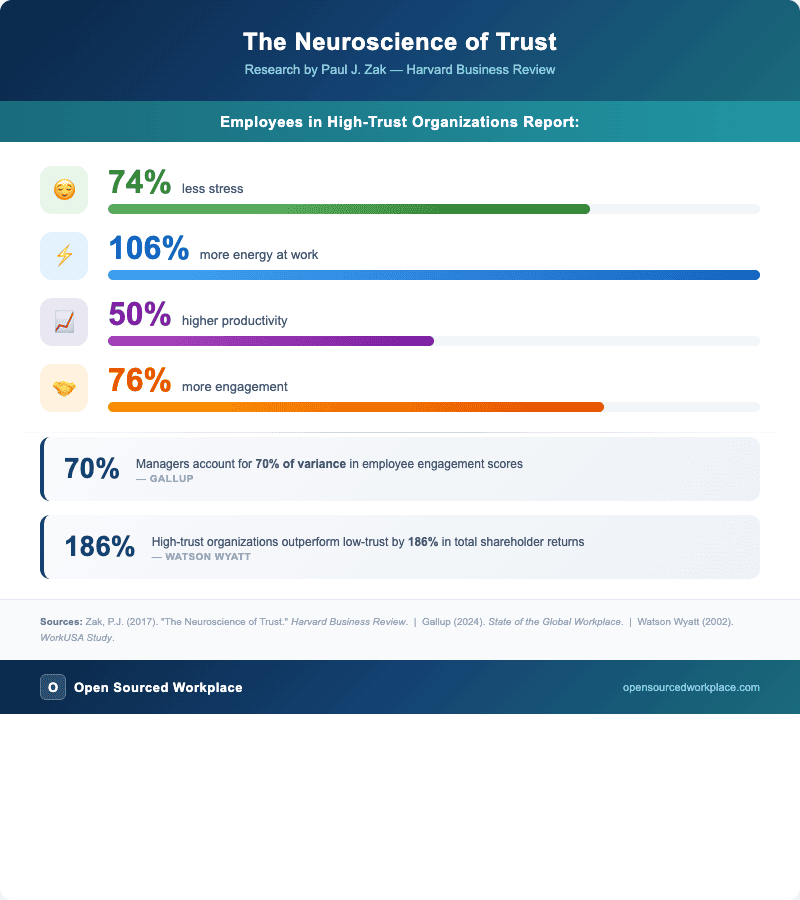
Workplace trust is no longer a speculative topic in organizational science. Neuroscientist Paul Zak at Claremont Graduate University has spent decades researching its neurological underpinnings. His findings, published in the Harvard Business Review , are striking: employees in high-trust companies report 74% less stress, 106% more energy at work, 50% higher productivity, and 76% more employee engagement than their low-trust counterparts.
Oxytocin sits at the center of all of it — sometimes called the trust molecule. When it releases in the brain, cooperation increases, fear responses diminish, and people become more willing to take calculated risks. In practical terms, a team operating in a high-trust environment is neurologically primed to collaborate, innovate, and push through difficulty.
Strip away that trust at work and the brain’s threat-detection systems stay chronically activated. Cortisol — the stress hormone — stays elevated. Decision-making turns risk-averse. Creative thinking narrows. People stop volunteering ideas because the psychological cost of being wrong feels too high. An organization does not just lose engagement; it loses cognitive capacity.
Key Research Findings That Connect Workplace Trust to Measurable Outcomes
The data on workplace trust is both extensive and unambiguous. A landmark study by Watson Wyatt found that high-trust organizations outperform low-trust counterparts by 186% in total returns to shareholders. Not a marginal difference — transformational.
The 2024 Edelman Trust Barometer Special Report: Trust at Work — drawing on 7,999 employees across eight countries — found a striking polarization: executives are 2.5 times more likely than frontline associates to trust their CEO to tell the truth about what is happening within their organization. That trust gap directly suppresses employee performance. Associates with low economic optimism — a downstream effect of low trust — are 20 percentage points less likely to take on additional work and 15 points less likely to feel motivated to perform at their best.
Google’s Project Aristotle, a multi-year study into what makes teams effective, concluded that the single biggest predictor of team performance was not individual talent, educational pedigree, or technical skill. Psychological safety — a form of interpersonal trust at work — came first, followed closely by dependability, which functions as a proxy for competence. Their findings are documented at re:Work by Google.
Trust at work creates the conditions in which competence can be demonstrated and developed. High-performing teams consistently show that without it, even highly skilled employees withhold their best efforts. That connection is not coincidental — it is causal.
How Oxytocin, Psychological Safety, and Brain Chemistry Drive Daily Performance
At its neurological core, the daily experience of work is a continuous cycle of threat assessment and reward response. Every interaction — a feedback conversation, a team meeting, a one-on-one with a manager — triggers a cascade of neurochemical responses that either open or close the brain’s capacity for high-order functioning. Team performance, in this sense, is a collective neurological output.
Amy Edmondson of Harvard Business School, whose groundbreaking research on psychological safety has become foundational in organizational science, defines the concept as a shared belief that the team is safe for interpersonal risk-taking. When psychological safety is high, people ask for help, share half-formed ideas, and admit mistakes early — all behaviors that accelerate learning and performance.
When safety is low, the opposite plays out. People perform for the gallery rather than for real outcomes. They hide problems. They avoid the difficult conversations that could prevent cascading failure. In low-safety environments, the brain’s social pain network activates in response to perceived threats of rejection or humiliation — the same network that processes physical pain. Social risk feels neurologically real, because it is.
Defining Competence Beyond the Job Description
Why Competence Is More Than Skills on a Resume
Talent management has a reductive habit: conflating competence with credentials. A degree, a certification, years of experience in a role. Useful signals, certainly. But extraordinarily incomplete proxies for actual workplace competence — and even further from what drives sustained performance.
Real competence is dynamic. It is the ability to apply knowledge in context, to adapt when the context shifts, to synthesize across domains, and to do all of this in ways that produce value for others. A person can be technically brilliant and organizationally inept. They can have flawless domain expertise and catastrophic interpersonal judgment. Both represent a competence deficit, even if the resume says otherwise.
The people who outperform are not always those with the most impressive credentials – and I include myself in this bucket – but they are those who know what they know, know what they do not know, and can navigate both with honesty.
The Three Dimensions of Workplace Competence Most Leaders Overlook
Competence in the workplace operates across three interlocking dimensions that most performance frameworks collapse into one:
- Technical competence: The domain-specific knowledge and skills required to perform a defined function. Most hiring processes evaluate this — and it is the least predictive of long-term high employee performance.
- Contextual competence: The ability to read organizational dynamics, understand stakeholder priorities, and operate effectively within the specific cultural and systemic environment of the organization. Rarely taught and almost never formally assessed.
- Adaptive competence: The capacity to learn, unlearn, and relearn as conditions change. In an era of accelerating technological disruption and evolving work modalities, arguably the most valuable dimension of all — and the one most organizations measure least.
Leaders who develop all three dimensions in their teams build organizations that do not just perform well today. They build organizations capable of sustained employee performance through conditions that do not yet exist.
How Perceived Competence Shapes Team Dynamics and Individual Output
Perceived competence adds another crucial layer to team performance. How employees perceive their own capability — and how they believe others perceive it — has profound effects on motivation, risk-taking, and output quality.
Self-Determination Theory, developed by Deci and Ryan and supported by decades of empirical research (Deci & Ryan, 2000), identifies competence as one of three core psychological needs that drive intrinsic motivation and employee engagement. When people feel capable, they pursue mastery, take on stretch assignments, and invest discretionary effort. When they feel inadequate — whether that perception is accurate or not — they retreat to safe, predictable behaviors that protect their self-image but limit their contribution.
Feedback culture in an organization is not a soft amenity. A hard performance lever, in other words. Poorly delivered feedback can undermine perceived competence even when the intent is developmental. And when perceived competence erodes, output follows.
The Trust-Competence Matrix: Where Performance Lives
Understanding the Four Quadrants Every Leader Needs to Map Their Team Against
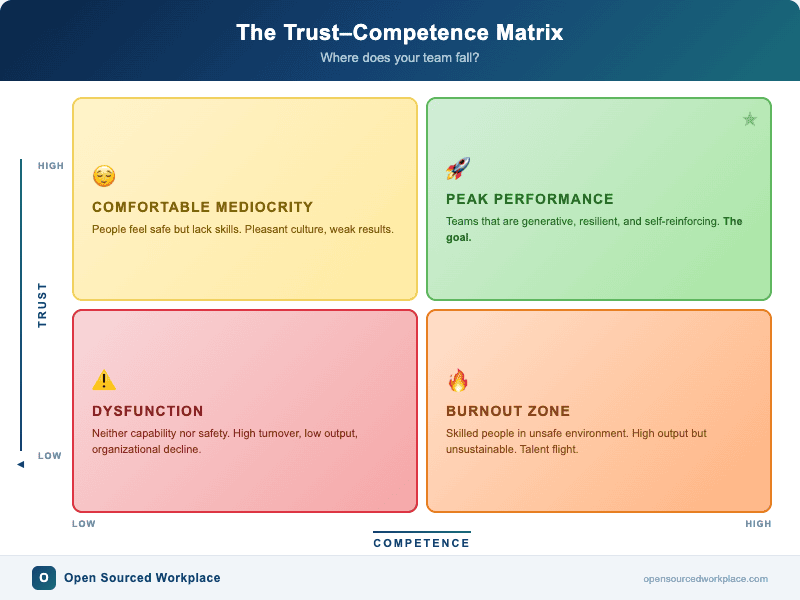
Trust and competence at work can be understood through a simple but powerful two-by-two matrix. On one axis: trust (low to high). On the other: competence (low to high). Each quadrant describes a distinct organizational reality with distinct employee performance implications.
Most leaders intuitively understand the extremes — the obvious high performer who is trusted and capable, the obvious poor performer who is neither. What gets systematically underestimated are the two middle quadrants, which represent the most common and most consequential performance challenges in real organizations.
High Trust, Low Competence: The Underperformance Trap No One Talks About
Organizationally comfortable and quietly devastating. These are the well-liked colleagues, the loyal long-tenured employees, the people whose interpersonal warmth generates enormous social capital even as their technical contribution plateaus or declines.
High trust creates a protective shield around performance accountability. Managers avoid competence conversations with people they like. Teams cover for these individuals because the relationship feels more important than the output gap. Over time, the organizational culture normalizes this underperformance, setting a ceiling on what the broader team believes is acceptable.
Addressing it requires one of the most demanding leadership skills: the ability to hold someone accountable while valuing the relationship. Separating affection from assessment — and most managers were never trained to do it.
Low Trust, High Competence: Why Your Best People Are Quietly Disengaging
Every leader should find this quadrant alarming, because it is where organizational attrition incubates invisibly. High-competence employees in low-trust environments do not typically explode in dramatic exits. They disengage incrementally.
They stop volunteering ideas. They stop going above the minimum. They start updating their LinkedIn profiles. And then one day they hand in their notice, and the organization is left holding an expertise gap it had no idea was forming.
Gallup’s State of the Global Workplace research finds that only a minority of employees are actively engaged. That low employee engagement is not primarily a capability problem — it is a trust and recognition problem. When talented people do not feel their contributions are seen, valued, and rewarded, the neurological reward circuitry that sustains motivation stops firing. See Gallup’s State of the Global Workplace 2023 for the full data.
High Trust, High Competence: What Peak Performance Actually Looks Like in Practice
Here is the organizational sweet spot. High-trust, high-competence teams are not just productive — they are generative. They create knowledge faster than they consume it. They attract talent because high performers want to work alongside other high performers in environments where they can be themselves. They innovate because psychological safety enables the kind of experimental thinking that generates breakthrough ideas.
High-performing teams in this quadrant are also resilient. When setbacks occur — and they always do — the trust infrastructure allows for rapid, honest diagnosis and recovery rather than defensive blame-shifting. Competence makes the recovery effective. Trust makes it fast.
Building and sustaining this quadrant is the central work of organizational leadership. Everything else is secondary to getting this right.
How Trust and Competence Interact to Drive or Destroy Performance
Why Trust Without Competence Creates a Culture of Comfortable Mediocrity
Organizations with strong trust cultures but weak competence development are warm but underperforming. They are the workplaces people describe as great places to work — until you examine the actual output quality, the pace of innovation, or the capacity to compete in a demanding market.
Trust without competence produces psychological safety without rigor. Teams feel safe enough to share ideas but lack the technical grounding to evaluate or execute them well. Lively collaboration, limited accountability for outcomes. Feedback loops gentle to the point of being uninformative.
Pleasant on the surface. A sluggish metabolism underneath. And because everyone is getting along, no one pushes hard enough to close the competence gaps that are quietly costing the organization its competitive position.
How Competence Without Trust Leads to Burnout and Talent Flight
High-competence, low-trust environments are among the most damaging workplace conditions that exist, precisely because they extract maximum output while providing minimum psychological sustenance. These organizations can sustain strong output for a period — often driven by competitive pressure or compelling mission — but they are metabolically unsustainable.
The burnout literature is unambiguous here. Research published in journals like the Journal of Occupational Health Psychology links chronic workplace stress — disproportionately associated with low-trust environments — to burnout, absenteeism, and turnover. Human cost incalculable. Organizational cost enormous and measurable.
Talented people in these environments eventually face a simple calculation: is the external validation of high performance worth the internal cost of operating in an environment that does not trust them? For the most capable people — the ones with the most options — that calculation increasingly favors departure, taking their employee engagement with them on the way out.
The Compounding Effect When Both Elements Align Across an Entire Team
When trust and competence are both high and reinforced rather than eroded by organizational systems, something remarkable happens, team performance exceeds the sum of its individual contributions. Not a motivational cliche — a measurable organizational phenomenon.
High-trust, high-competence teams share knowledge more freely, which accelerates individual capability development. They challenge each other constructively, which raises the quality of output. They attract and retain the best talent, which compounds over time into a durable competitive advantage.
That compounding dynamic is the real prize — not marginal improvement in quarterly metrics, but structural elevation of what the organization is capable of achieving, year after year.
The Leader’s Role in Building Both Trust and Competence Simultaneously
Why Leadership Behavior Is the Single Biggest Variable in Team Performance
Research here is unequivocal. A landmark Gallup study found that managers account for at least 70% of the variance in employee engagement scores. Not strategy. Not compensation. Not technology. The manager. That finding has been replicated across industries, geographies, and organizational sizes.
Trust at work and competence are not abstract organizational properties. They are the direct downstream consequences of thousands of discrete leadership behaviors — the way a manager responds when someone makes a mistake, the level of transparency they bring to difficult decisions, the seriousness with which they invest in developing their people. Leadership behavior, in this sense, shapes team output as much as individual capability.
Every interaction a leader has either deposits into or withdraws from the trust account. No neutral territory exists. And over time, the accumulated balance of those transactions determines the team performance ceiling.
Specific Daily Actions That Build or Erode Trust Faster Than Any Policy
Trust at work is not built through town halls and values statements. It is built in the granular texture of daily work. Here are the behaviors that matter most:
- Following through on small commitments: Leaders who do what they say they will do — reliably, even in minor matters — build a reputation for integrity that compounds into deep workplace trust.
- Acknowledging uncertainty honestly: In a culture that often rewards false confidence, leaders who say I do not know but I will find out create disproportionate trust precisely because it is rare.
- Sharing credit visibly and specifically: When leaders attribute success to their team members by name, in public contexts, they signal that contribution is seen and valued. That neurological reward response is immediate and lasting.
- Addressing poor performance promptly: Paradoxically, one of the most trust-building actions a leader can take is confronting underperformance directly and respectfully. High performers watch how leaders handle low employee performance. If they see it ignored, their trust in the leader’s judgment and fairness erodes rapidly.
- Being consistent across relationships: Workplace trust is destroyed faster by perceived favoritism than almost any other leadership behavior. People are exquisitely sensitive to differential treatment.
How to Develop Competence Without Micromanaging the Process
A persistent misconception holds that developing team competence requires intensive oversight. It does not. Micromanagement is one of the most reliable ways to simultaneously undermine competence development and erode trust.
Competence grows through stretch, feedback, and reflection — not surveillance. The role of the leader is to set clear outcome expectations, provide the resources and context needed for success, and create structured opportunities for learning from both success and failure.
Delegating meaningfully — assigning real work with real consequences, not just tasks that do not matter. Building in retrospective practices — brief, structured debriefs that extract learning from experience. Being available for guidance without becoming a bottleneck for decisions.
The Words and Behaviors That Signal Trust — and Those That Silently Destroy It
Stephen M.R. Covey’s framework in The Speed of Trust offers a useful anchor here. Covey argues that trust is built at the intersection of character and competence — and that the quickest way to erode trust is to violate a behavior of character, while the fastest way to build it is to demonstrate consistent competence. Every visible leadership action either deposits into or withdraws from what Covey calls the trust account. Small, consistent deposits compound over time. Withdrawals tend to be sudden and disproportionately costly.
Language matters more than most leaders realize. Words used in everyday work interactions carry implicit signals about trust and respect that employees decode with remarkable precision.
Trust-signaling language includes phrases that acknowledge contribution (your analysis shaped this decision), invite challenge (I could be wrong — what are you seeing that I’m not?), and demonstrate confidence in capability (I trust your judgment on this).
Trust-destroying language includes dismissive qualifications (that’s not a bad idea, but…), unsolicited corrections in public contexts, and the insidious use of rhetorical questions to mask criticism (Did you really think that would work?). Patterns that feel trivial in isolation. Their cumulative effect on psychological safety and perceived competence is anything but.
Real-World Signals That Trust or Competence Is Breaking Down
The Early Warning Signs Most Managers Miss Until It Is Too Late
Organizational dysfunction rarely announces itself dramatically. It accumulates through patterns that are individually easy to rationalize but collectively unmistakable — if you are paying attention.
Watch for these early indicators of eroding trust or competence:
- A decline in the quality or frequency of questions asked in team settings. When people stop asking questions, they have either stopped caring or stopped feeling safe enough to expose their uncertainty. Both are serious signals worth acting on.
- Increasing email and decreasing conversation. When teams shift from real-time collaborative dialogue to written record-keeping, it often signals that trust has eroded enough that people feel they need to protect themselves in writing.
- Side channels and shadow discussions that re-litigate what was ostensibly resolved in formal meetings. When the formal space is no longer trusted for authentic exchange, decisions migrate to the corridor and the private Slack thread.
- High performers volunteering for fewer stretch assignments. When capable people stop putting themselves forward, something has changed in their assessment of what the organization offers them in return for the risk.
How to Read Team Body Language, Communication Patterns, and Output Trends
Performance data tells you what is happening. Communication patterns tell you why. Leaders who develop the diagnostic skill of reading both simultaneously gain an enormous advantage in catching problems early.
In in-person and hybrid settings, watch for non-verbal cues in collaborative contexts: who defers to whom, who goes quiet when certain topics arise, who physically disengages during particular conversations. Not random. Each maps directly onto the trust and competence dynamics affecting team performance.
In asynchronous and remote contexts, communication pattern analysis becomes even more important. Response latency in collaborative tools, the proportion of substantive versus perfunctory contributions, the ratio of questions to statements in discussion threads — all provide signal about the health of the underlying trust and competence infrastructure.
When to Intervene and Exactly How to Do It Without Making Things Worse
Timing and manner of intervention are as consequential as the intervention itself. Intervening too early can pathologize normal team development. Too late, and dysfunction becomes structural.
Intervene at the pattern level, not the incident level. A single heated exchange does not require organizational intervention. A recurring pattern of communication breakdown, knowledge hoarding, or accountability avoidance absolutely does.
Do it privately before publicly. Naming a trust or competence breakdown in a group setting before the individuals involved have been privately briefed almost always escalates rather than resolves the issue. Create the conditions for honest private dialogue first, then work toward collective acknowledgment and course correction.
Measuring What Matters: Tracking Trust and Competence in Your Team
Why You Cannot Manage What You Do Not Measure
Often attributed to Peter Drucker, this principle is frequently cited and almost as frequently misapplied. Whether to measure is not the issue — what to measure and how to interpret the data in context is.
Neither trust nor competence is immune to measurement. Harder to quantify than revenue or headcount, certainly. But that difficulty is not a reason to avoid the attempt. It is a reason to be thoughtful about the measurement approach.
Practical Tools and Frameworks for Assessing Trust Levels Across Your Team
Several validated instruments exist for measuring workplace trust. Paul Zak’s research group offers the Organizational Trust Index. The Great Place To Work Trust Index has been used across hundreds of thousands of organizations globally and remains one of the most respected benchmarks for high-performing teams. For teams without access to formal instruments, a well-designed pulse survey can provide meaningful directional data on trust dimensions.
Worth measuring confidence in leadership, perceived fairness of processes, belief that contributions are recognized, comfort with expressing disagreement, and willingness to take risks. Each maps directly onto the neuroscience and organizational research reviewed earlier in this article.
How to Evaluate Competence Gaps Without Triggering Defensiveness or Fear
Competence assessment is one of the most psychologically fraught conversations in organizational life. Competence is entangled with identity. Telling someone their skills are inadequate feels, neurologically, like a threat to their social standing. The amygdala activates. Defensiveness follows.
Frame competence assessment as a growth conversation rather than a judgment. Not semantic cosmetics — it requires a developmental intent on the part of the leader, communicated through both process and language. Growth is the goal, not an audit of past failure.
Effective approaches include co-developing competence frameworks with team members rather than imposing them, using 360-degree feedback processes that normalize developmental gaps as universal rather than exceptional, and anchoring competence conversations in future capability needs rather than past performance deficits.
Using Pulse Surveys, One-on-Ones, and Performance Data Together
No single data source tells the full story. Pulse surveys provide aggregate signal but lose individual nuance. One-on-ones provide rich qualitative depth but are susceptible to impression management. Performance data provides outcome evidence but cannot explain the causes behind it.
Sophisticated leaders use all three in an integrated diagnostic system. Pulse survey data surfaces themes for one-on-one exploration. One-on-one conversations illuminate the human dynamics behind performance data anomalies. Performance data provides the accountability anchor that ensures conversations remain connected to real organizational outcomes.
Building a High-Performance Culture Through Trust and Competence
The Structural Changes That Make Trust and Competence the Default, Not the Exception
Individual leadership behavior matters enormously, but it is not sufficient. Organizational culture is ultimately determined by systems — the processes, policies, incentives, and structures that shape behavior at scale and outlast any individual leader’s tenure.
Organizations that embed trust and competence into their structural DNA make specific design choices: they build psychological safety into their performance management frameworks, not just their value statements; they reward competence development explicitly and visibly, not just competence deployment; they design feedback systems that normalize developmental conversation as a continuous practice rather than an annual event.
Choices about what not to do matter just as much. Ranking systems that put colleagues into zero-sum competition with each other are structurally incompatible with the trust required for high performance. Microsoft’s dismantling of its notorious stack-ranking system in 2013 and the subsequent improvement in its organizational culture and innovation output is a well-documented case study in this principle.
How Hybrid Work Has Shifted the Trust-Competence Dynamic Permanently
The post-pandemic normalization of hybrid work has fundamentally altered the conditions under which trust and competence are built and assessed. Many of the informal trust-building mechanisms that characterized co-located work — the ambient social signals, the spontaneous corridor conversations, the visible daily presence — are no longer reliably available in a hybrid work environment.
Two distinct challenges emerge from hybrid work’s permanence. First, leaders must build and maintain trust through intentional, designed interactions rather than organic proximity. Second, competence assessment becomes harder when work is less visible, which creates a risk of both under-recognition of strong performance and delayed identification of competence gaps.
Organizations navigating this most effectively are those that have redefined what proximity means — shifting from physical co-location to intentional connection, and from visibility-based performance assessment to outcomes-based accountability. Both shifts require a deeper institutional trust to function.
Creating Psychological Safety as the Foundation for Competence Development
Amy Edmondson’s research demonstrates that psychological safety is not a prerequisite for high standards — it is what makes high standards achievable. Her work on teaming shows that high-performing teams with strong psychological safety are more likely to learn from failures, more likely to surface problems early, and ultimately more likely to achieve ambitious employee performance goals.
Organizations that invest in psychological safety — through leadership modeling, facilitated team practices, and structural incentives for transparency — are not creating cozy environments where accountability disappears. They are creating environments where accountability can be real rather than performative, because people feel safe enough to tell the truth.
Why Onboarding Is Your Biggest Untapped Trust-Building Opportunity
Onboarding is the most leveraged trust-building window in the employee lifecycle. Research from the Society for Human Resource Management suggests that effective onboarding can improve new employee retention by as much as 82% and productivity by over 70%. Yet most organizations treat onboarding as an administrative orientation rather than a strategic trust-building investment.
Those first 90 days set the psychological template through which an employee will interpret every subsequent organizational experience. If they learn, in those first weeks, that the organization follows through on its commitments, invests in their development, and treats them as a capable adult — they will carry that template of trust forward. If they learn the opposite, they will carry that forward too, and their employee engagement will reflect it from day one.
Getting it right costs relatively little. Getting it wrong compounds across the entire tenure of every employee.
Case Studies: What High-Trust, High-Competence Teams Actually Look Like
Lessons from Organizations That Cracked the Performance Code
Netflix is perhaps the most cited example of an organization that built a high-trust, high-competence organizational culture deliberately and systematically. Their Culture Deck, developed under Reed Hastings and Patty McCord, articulated a philosophy of radical transparency and deliberate competence development that has become a reference point for organizational design globally. High performers in a high-trust environment outperform any other configuration — that premise has been validated empirically by Netflix’s sustained competitive dominance.
Bridgewater Associates, the world’s largest hedge fund, built its culture on what founder Ray Dalio calls radical transparency — a commitment to truth-telling and honest assessment of both ideas and performance that is, by most accounts, deeply uncomfortable to operate within. Yet Bridgewater’s performance track record is extraordinary. The correlation between their cultural intensity and their performance outcomes is not accidental.
In the healthcare sector, research on high-reliability organizations — particularly surgical teams — shows that trust-based communication protocols reduce error rates and improve outcomes in ways that technical training alone cannot achieve. Amy Edmondson’s work on psychological safety in hospital teams is particularly instructive here.
The Patterns That Show Up in Top-Performing Teams
Across industries and organizational contexts, certain patterns appear with striking regularity in high-performing teams where both workplace trust and competence are strong:
- Explicit norms around how disagreement is handled — not avoiding it but channeling it productively.
- Investment in retrospective learning as a regular practice, not just in response to failure.
- Leaders who model vulnerability by acknowledging their own developmental edges, which gives permission for the team to do the same.
- Decision-making authority distributed in ways that match competence to accountability — not concentrating all decisions at the top.
- Celebration of learning milestones alongside employee performance milestones, signaling that growth is as valued as output.
What These Teams Do Differently in Meetings, Feedback, and Daily Work
Behavioral micro-patterns of these teams are distinctive. In meetings, they spend less time on status reporting and more time on collaborative problem-solving, because information flows freely enough that status updates are largely unnecessary. Dissenting views are invited and engaged with rather than politely absorbed and subsequently ignored.
Feedback is continuous, specific, and bidirectional. It flows upward as readily as downward. Senior leaders receive candid input from their teams without the ritual softening that characterizes low-trust feedback cultures.
In daily work, there is a visible willingness to work in public — to share drafts, surface half-formed thinking, and ask for input before polishing rather than after. That collaborative exposure is only possible in conditions of sufficient trust, and it dramatically accelerates both individual learning and collective output quality.
Your Action Plan: From Insight to Implementation
A Practical 30-Day Roadmap for Leaders Ready to Close the Trust-Competence Gap
Insight without action is organizational entertainment. Here is a practical 30-day roadmap for leaders who are ready to move from understanding the trust-competence connection to actively building it — and improving employee performance in the process:
Days 1-7: Diagnosis. Map your team against the trust-competence matrix. Be honest about where each person sits. Conduct informal pulse conversations — not formal surveys — that invite candid feedback about what enables and constrains their best work.
Days 8-14: Individual conversations. Have direct, private conversations with each team member about their experience of trust and their sense of their own competence trajectory. Ask what one thing you could do differently to better support them. Listen more than you speak.
Days 15-21: Structural audit. Review your team’s processes and norms against the research on psychological safety and competence development. Identify the two or three structural changes with the highest leverage. Pick the highest-impact interventions and commit to them fully.
Days 22-30: Visible action. Implement the changes you identified. Communicate explicitly to your team what you are doing and why. Visible intentionality is itself a trust signal. Follow up on commitments made in individual conversations. Follow-through matters as much as the conversation.
The Five Commitments Every Leader Must Make to Sustain High Performance
- Commit to consistency: Your team will trust you at the level of your worst day. Emotional and behavioral variability is corrosive to trust. Commit to steadiness, especially under pressure.
- Commit to honest competence conversations: Do not let competence gaps fester out of interpersonal discomfort. Telling someone clearly and early what needs to develop is the kindest thing a leader can do — and one of the highest-leverage interventions for employee performance.
- Commit to continuous learning yourself: A leader who visibly models learning and developmental humility gives their team permission to do the same. Non-negotiable for leaders in high-change environments.
- Commit to structural accountability: Trust and competence are not sustained by individual goodwill alone. Build them into your team’s operating rhythms — your meeting practices, your feedback processes, your recognition systems.
- Commit to the long view: Trust compounds slowly and erodes quickly. Leaders who build the most extraordinary teams are those willing to invest in the foundations without expecting immediate return.
How to Bring Your Team into the Conversation Without Losing Authority or Momentum
One of the most common concerns leaders express when they want to address trust and competence dynamics is the fear that naming the issue will destabilize the team or undermine their authority. In my experience, the opposite is almost always true.
Teams are acutely aware of these dynamics whether or not leaders name them. When a leader demonstrates the courage and self-awareness to bring these dynamics into explicit conversation, they almost invariably gain credibility rather than losing it.
Frame it not as a diagnostic presentation of everything that is wrong, but as an invitation: I want us to be the best team this organization has ever seen, and I believe the way we get there is by being honest about what enables and what constrains our best work. I want to hear from you.
That invitation, delivered with real intent and followed through with visible action, is one of the highest leveraged moves available to a leader.
The Bottom Line on Trust, Competence, and Performance
What the Research Ultimately Tells Us About Sustainable Employee Performance
Organizational science, neuroscience, and empirical data point in one direction with striking consistency: sustainable employee performance is not primarily a function of strategy, technology, or talent acquisition. It is a function of the relational and developmental conditions in which talent operates.
Trust and competence are not the soft underpinning of the real work. They are the real work. Organizations that treat both as foundational and outperform those that do not, across every meaningful performance metric, over every meaningful time horizon.
Why This Is Not a Soft Skills Conversation — It Is a Business Results Conversation
Let me be unambiguous on this point, because I know how these conversations can be received in high-performance commercial environments where the currency of credibility is hard numbers.
Organizations with the highest trust scores in comprehensive, longitudinal studies outperform their industries on revenue growth, shareholder returns, customer satisfaction, and talent retention. High trust drives employee engagement and, through it, business results. Not correlations driven by organizational feel-good factors — causal relationships supported by neurological, psychological, and financial evidence accumulated across decades of rigorous research.
Invest in trust and competence, and you are investing in a performance multiplier that affects every other organizational initiative. The ROI is not soft. It is profound.
The One Shift in Mindset That Changes How You Lead From This Point Forward
One reorientation synthesizes everything in this article: stop managing outputs and start building conditions.
Outputs will follow — with a reliability and a magnitude that purely output-focused management almost never achieves. When people trust the environment they are in and feel capable within it, they bring everything they have. Not because they are managed into it. Because they cannot imagine doing anything less.
That is the performance dividend that trust and competence at work pay. Available to every leader willing to do the foundational work.
Related Questions
What is the relationship between trust and competence in the workplace?
Trust and competence in the workplace have a compounding relationship — each amplifies or undermines the other. Competence without trust produces disengagement: skilled people withhold their best effort because the environment feels unsafe to take risks, admit gaps, or surface problems early. Trust without competence produces comfortable mediocrity: teams feel psychologically safe but lack the technical grounding to execute at a high level. When both are deliberately built together, the effect compounds. High-trust organizations outperform low-trust counterparts by 186% in total shareholder returns, and research consistently shows that psychological safety — the interpersonal dimension of trust — is the single biggest predictor of team performance. The relationship is not incidental. Trust creates the conditions in which competence can be demonstrated, developed, and applied. Competence, in turn, gives people something worth trusting each other to do.
What happens when employees have high competence but low trust in their organization?
High competence in a low-trust environment is one of the most costly combinations in organizational life — and one of the least visible until it is too late. Highly capable employees do not typically quit the moment trust erodes. They disengage incrementally: they stop volunteering ideas, stop going above the minimum, and start quietly exploring alternatives. Gallup research consistently finds that low employee engagement is not primarily a capability problem — it is a trust and recognition problem. The neurological mechanism is straightforward: when trust is absent, the brain threat-detection systems stay elevated. Cortisol suppresses the kind of creative, collaborative thinking that high performance requires. The most capable people — those with the most options — eventually make a simple calculation about whether the environment is worth their best effort. When the answer turns negative, they leave. Retaining high-competence talent requires building the trust conditions that make staying worthwhile.
How do you measure trust and competence in a team?
Trust and competence are measurable, though neither shows up on a standard performance dashboard. For trust, validated instruments include Paul Zak’s Organizational Trust Index and the Great Place To Work Trust Index, both of which assess dimensions like confidence in leadership, perceived fairness, and willingness to take interpersonal risks. Pulse surveys designed around these dimensions can provide directional data without formal instruments. Behavioral indicators are equally useful: the frequency and quality of questions asked in team settings, whether problems surface early or late, and whether all team members give consistent messaging to the broader organization — a signal that collective trust and alignment are working. For competence, the most effective approaches separate technical competence from contextual and adaptive competence, use 360-degree feedback to normalize developmental gaps, and anchor conversations in future capability needs rather than past deficits. Sophisticated leaders combine pulse surveys, one-on-one conversations, and performance data as an integrated diagnostic system rather than relying on any single source.
How long does it take to rebuild trust once it has been broken in a team?
The timeline for rebuilding trust depends heavily on the severity and perceived intentionality of the breach. Minor violations — a missed commitment, a poorly handled feedback conversation — can typically be repaired within weeks through consistent counter-behavior. More significant breaches — visible unfairness, breach of confidentiality, public humiliation — can take months to years and may permanently alter the trust dynamics of a team. Research on trust repair, including work by Kim, Dirks, and Cooper published in the Academy of Management Review, identifies three critical variables in accelerating recovery: acknowledging the breach specifically rather than generically, taking genuine accountability rather than offering explanations, and demonstrating changed behavior over a sustained period. Stephen M.R. Covey’s observation in The Speed of Trust is instructive here: trust is lost most quickly through violations of character but rebuilt most reliably through demonstrated competence — consistent delivery on commitments that re-establishes credibility before the deeper relational trust can be restored.
Sources and Further Reading
The following sources informed this article and are recommended for further exploration:
- Zak, P.J. (2017). The Neuroscience of Trust. Harvard Business Review.
- Google re:Work. (2016). Guide: Understand team effectiveness.
- Edmondson, A.C. (1999). Psychological Safety and Learning Behavior in Work Teams. Administrative Science Quarterly.
- Deci, E.L. & Ryan, R.M. (2000). Self-Determination Theory.
- Gallup. (2023). State of the Global Workplace Report.
- Gallup. (2015). Managers Account for 70% of Variance in Employee Engagement.
- Great Place To Work. Trust Index.
- Netflix Culture Deck.
- Bridgewater Associates. Research and Insights.
- Edmondson, A.C. Psychological Safety Resources.
- Edelman. (2024). Trust Barometer Special Report: Trust at Work.
- Covey, S.M.R. (2006). The Speed of Trust. Simon & Schuster.
Recent Posts
Nobody Told Us AI Would Make Us Feel Like We're Bad at Our Jobs
Why AI gives HR professionals generic outputs — and why it was never your fault. If you're an HR professional finding that AI outputs feel generic, shallow, or unusable for real HR work — the...
Stop Blending Portfolio Strategy With Workplace Strategy: Where One Ends and the Other Begins
Most organizations don’t set out to conflate their portfolio and workplace strategies. It happens gradually, subtly, as language blurs and responsibilities overlap. A real estate team starts...