

Quick Answer: Yes, providing drinking water at work is a federal legal requirement in the United States. Under OSHA standard 29 CFR 1910.141, every employer must supply potable — that is, safe-to-drink — water to all employees, free of charge. This applies to virtually every workplace: offices, construction sites, warehouses, and beyond. Failure to comply can result in OSHA citations and financial penalties. Read on for the full breakdown of what the law requires, how much water you should actually provide, and why well-hydrated employees are measurably good for your bottom line.
What Does the Law Actually Say?
Providing free, safe drinking water to your workforce isn’t a courtesy — it’s the law. Full stop. The Occupational Safety and Health Administration (OSHA) mandates it under 29 CFR 1910.141, which covers sanitation in general industry workplaces. For construction sites, the analogous standard is 29 CFR 1926.51. These regulations aren’t suggestions. They carry real enforcement weight, and OSHA inspectors check for compliance during routine site visits.
OSHA’s core requirement is this: employers shall provide employees with potable water — defined as water meeting the standards of the EPA’s Safe Drinking Water Act — and that water must be free. No vending machines. No cost-recovery schemes. No exceptions. In my experience reviewing workplace compliance audits, the vending machine substitution is one of the most common — and easily avoidable — violations I’ve come across.
The law also governs the manner of delivery. Shared cups or communal ladles are prohibited outright, because cross-contamination through saliva is a legitimate health hazard. Employers must provide single-use disposable cups, individual bottles, or a properly maintained drinking fountain. And a bathroom sink does not qualify. OSHA is explicit on this point. I’ve seen facilities managers argue otherwise during audits; they lose that argument every time.
What the OSHA Provisions Actually Require
Rather than list the requirements as bullet points, let me walk you through how they connect in practice. Potable water must be available throughout the entire workday — not just during scheduled breaks, not just when the cooler hasn’t run out. Delivery must be through individual vessels or fountains; containers and dispensing equipment must be kept clean and sanitary. The sharing of drinking vessels is prohibited. And there must be enough water for everyone on-site — not a 12-pack for 20 people with a crossed-fingers approach to rationing.
The interaction with the Safe Drinking Water Act is worth understanding too. The SDWA places primary responsibility for water quality on municipal suppliers and the EPA. But that doesn’t absolve employers entirely. If a company knows its building’s plumbing has issues — old pipes, lead contamination, bacterial growth in stagnant lines — it has a duty to act, whether through filtration or an alternative supply. The “it’s the city’s problem” defense has not held up well in OSHA proceedings.

How Much Water Is Enough? Working Out the Numbers
The question I get asked most often by HR managers and facilities teams is a practical one: how much water do we actually need to provide? OSHA doesn’t specify a volume, so let’s work it out properly.
The U.S. National Academies of Sciences, Engineering, and Medicine recommends a total daily water intake of around 3.7 liters (125 oz) for men and 2.7 liters (91 oz) for women, sourced from both food and beverages. The widely-cited “8 glasses a day” heuristic works out to 64 ounces. An 8-hour workday represents roughly half of waking hours, so 32 ounces per employee — two standard 16.9 oz bottles — is a defensible baseline for a sedentary, climate-controlled office environment. I’ve used this figure in internal planning documents for years and it’s never been challenged by an OSHA inspector as insufficient for white-collar settings.
Physical labor changes the calculation entirely. OSHA’s Heat Illness Prevention guidelines recommend one cup (8 oz) of water every 15–20 minutes for workers exposed to heat — roughly a quart per hour. That’s four to five times the sedentary office baseline. For outdoor roles in summer, or any work environment where core body temperature rises appreciably, planning around that quart-per-hour figure is not overcautious; it’s operationally sound and legally protective.
When the Water Goes Off: Temporary Outages
Here’s a scenario that catches facilities managers off guard: a burst pipe, a water main break, a scheduled shutoff for building works. What are the obligations?
OSHA’s standards were written for normal operating conditions, but the intent is clear — employees must have access to potable water while at work. No running water also means likely violations of sanitation requirements around toilet facilities and handwashing stations. In practice, most occupational safety professionals — and I would echo this recommendation — advise sending employees home or relocating them until the supply is restored. A contingency stock of bottled water covers short outages; anything beyond a few hours warrants suspension of operations rather than a compliance gamble.
Filtration and Water Quality: Going Beyond Minimum Compliance
Meeting the legal standard is the floor, not the ambition. In older buildings — particularly those constructed before 1986, when lead solder was still permitted in plumbing — pipes can leach contaminants into the supply even when the municipal water arriving at the building is technically compliant. The EPA’s Lead and Copper Rule governs allowable levels in municipal water, but internal building plumbing sits largely outside its reach.
The Flint, Michigan water crisis made viscerally clear what happens when that gap goes unaddressed. Even regulated municipal supplies can fail. For employers in older facilities, commissioning a water quality test from a certified laboratory is a prudent step regardless of whether OSHA requires it. The cost is typically $150–$400. The liability protection — and the peace of mind — is worth considerably more than that.
Point-of-use filtration is the practical solution for most workplaces. Pitcher-style filters handle small teams adequately. Tap-mounted units work well in break rooms. For larger operations, a plumbed-in reverse osmosis system can eliminate the vast majority of contaminants — heavy metals, chlorine byproducts, microbial agents — and typically pays for itself within two to three years compared to bottled water costs at scale.
Choosing Your Delivery Method: An Honest Comparison
Bottled water is the easiest to deploy but the most expensive per unit, and the environmental footprint is substantial enough that many sustainability-minded organizations are moving away from it. Drinking fountains have low ongoing cost but require consistent sanitizing routines — post-pandemic, touchless models have become the sensible default for any new installation. Plumbed-in point-of-use coolers are, in my view, the strongest all-round option for offices with more than 15 or so employees: chilled still or sparkling water on demand, no bottle logistics, minimal waste. Brands like Bevi and Quench have taken significant market share in U.S. corporate settings for exactly this reason.
The Business Case: Why This Is Worth More Than Compliance
Mandatory compliance aside, the affirmative business case for workplace hydration is more robust than most leaders appreciate. Let me walk through the research that actually shifts the needle in leadership conversations.
Cognition, Focus, and Productivity
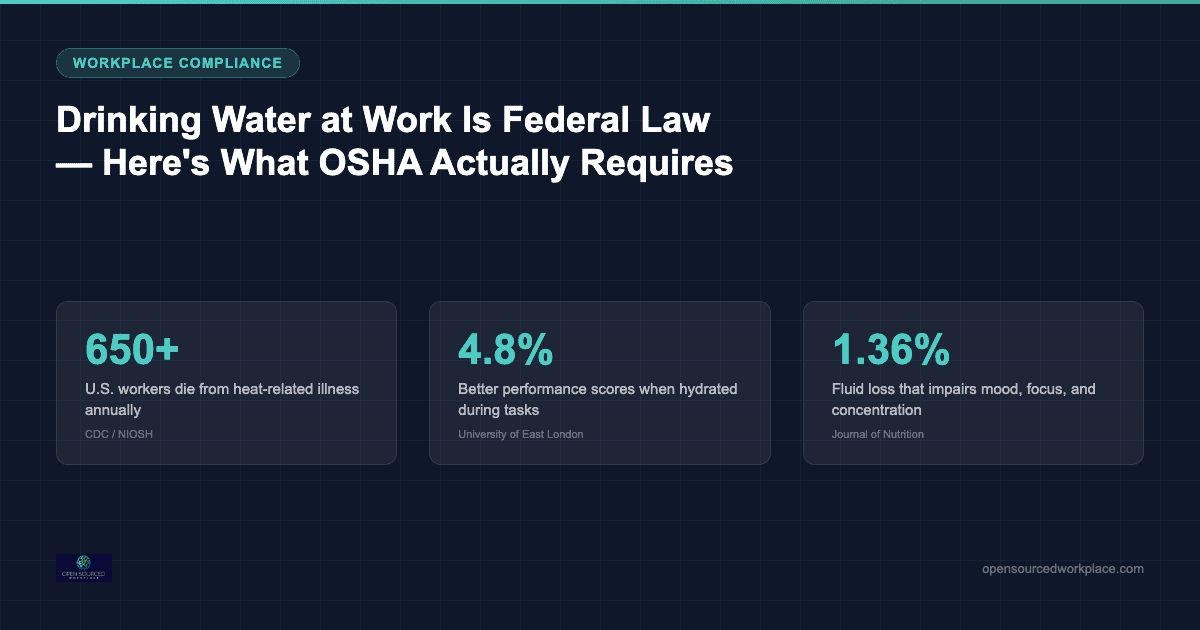
Even mild dehydration measurably impairs cognitive performance. A landmark study published in the Journal of Nutrition found that a fluid loss of just 1.36% in women was sufficient to impair mood, increase headache frequency, and reduce concentration. A separate study from the University of East London and the University of Westminster found that students who brought water into examination rooms achieved 4.8% better grades on average. That’s a controlled academic setting, but the neurological mechanism is identical in a boardroom or at a call center workstation.
For knowledge workers — whose entire value proposition is cognitive output — this is not a peripheral concern. An employee who is even mildly dehydrated for three or four hours of an eight-hour day is operating below capacity for a material fraction of their compensated time. Given that the average U.S. employer spends around $14,000 per employee annually on wages in non-skilled roles, and considerably more for specialist positions, the cost of suboptimal performance across a team dwarfs the annual spend on a decent water cooler contract. I have put this calculation in front of CFOs and it lands.
Absenteeism and Health Costs
Chronic dehydration is associated with urinary tract infections, kidney stones, constipation, and impaired immune function — all of which translate into sick days, reduced output, and in self-insured health plan contexts, direct claims costs. Research published in the American Journal of Epidemiology found that adults drinking more than five glasses of water per day were significantly less likely to experience fatal coronary heart disease. For employers operating under high-deductible health arrangements, the actuarial logic of hydration as a wellness intervention is genuinely compelling.
Mood, Morale, and Team Dynamics
Water’s relationship with mood is consistently underestimated in corporate wellness conversations. Research from Tufts University found that low-level dehydration produced significant fatigue and negative mood in young adults. In workplace terms, that manifests as diminished collaboration, elevated irritability, and degraded conflict resolution — none of which appear as a line item in management accounts, but all of which erode team performance in ways that compound over time.
I’ve seen this play out practically. One facilities director I worked with upgraded from a single warm water cooler serving 60 people to four chilled point-of-use units distributed across the floor. Subsequent employee satisfaction scores — which had been running flat — ticked up measurably in the next quarterly pulse survey. Correlation isn’t causation, but the direction of travel was consistent with the research.
Recognizing Dehydration at Work: What Supervisors Need to Know
Understanding the progressive stages of dehydration matters especially in industries involving physical labor, outdoor work, or hot environments. Supervisors who can recognize early signs protect both their employees and their organization from escalating liability.
Mild Dehydration (1–2% fluid loss)
The first signals are easy to dismiss: persistent thirst, a dry mouth, slightly darker urine. Mild fatigue and a low-grade headache follow. These symptoms are reversible quickly with water and a rest break. The problem is that at this stage, employees often don’t flag it — they push through. That’s when mild dehydration starts affecting cognitive output without anyone noticing.
Moderate Dehydration (3–5% fluid loss)
Moderate dehydration announces itself more clearly: significantly reduced urination, an elevated heart rate, reduced blood pressure, and the classic skin-tenting sign when pinched. Marked fatigue and cognitive impairment become difficult to ignore. At this stage, water alone may be insufficient. Electrolyte replacement — sodium, potassium, magnesium — becomes necessary because perspiration depletes minerals alongside fluid. Sports drinks or electrolyte tablets are appropriate here, not just a trip to the water cooler.
Severe Dehydration — A Medical Emergency
Severe dehydration, beyond 5% fluid loss, is a medical emergency. Profound confusion, inability to retain fluids, rapid shallow breathing, and in extreme cases, loss of consciousness. Core temperature spikes; heat exhaustion transitions to heatstroke, which carries a meaningful mortality rate without prompt medical intervention.
The CDC’s occupational heat stress data is stark: more than 650 workers in the United States die from heat-related illness every year, and thousands more suffer non-fatal heat stress. The overwhelming majority of those cases are preventable. For employers in construction, agriculture, warehousing, and outdoor services, this is not a statistical abstraction — it is a foreseeable risk with foreseeable prevention measures.
OSHA Heat Illness Rule (2024 update): OSHA proposed a new Heat Injury and Illness Prevention standard in 2024, which would formalize water access requirements, mandatory rest breaks, and shade provisions for outdoor and indoor workers exposed to heat. The rulemaking is ongoing, but the underlying duty-of-care obligation exists today under OSHA’s General Duty Clause. Current status and employer guidance at OSHA’s Heat Illness Prevention page.
A Practical Compliance Framework for Employers
Whether you’re running a 10-person startup or managing a multi-site operation, the following framework covers the ground that OSHA inspectors actually check — and the steps that make a material difference to employee health outcomes.
Start with a water access audit. Walk the facility and map every current potable water source against the floor plan. OSHA implies that water should be reasonably accessible — not a quarter-mile hike across a warehouse floor. If the nearest source is more than two or three minutes’ walk from any workstation, that’s a problem worth solving before an inspector does it for you.
If your facility currently relies on bathroom sinks for drinking water access, that needs to change immediately. This is not a gray area and the fix is not expensive. A countertop filter unit or a point-of-use cooler resolves it.
Provision individual vessels. Whether that’s disposable cups at a cooler, company-branded reusable bottles, or a fountain with single-use cup dispensers, shared drinking vessels cannot exist in a compliant workplace. Scale the supply to workforce size and shift patterns — a team of 50 requires a meaningfully different setup than a team of five, and the calculation changes again for any role involving physical exertion or outdoor exposure.
Test water quality in older buildings. Commission a certified laboratory test if your facility predates 1986. Budget $150–$400 for it. The liability protection is disproportionate to that cost.
Finally, train supervisors. Frontline managers should be able to recognize the early signs of dehydration and know when to intervene — not because they’re expected to be medics, but because early recognition prevents escalation to medical emergencies. Half an hour of training on this during onboarding is time well spent.
FREE RESOURCE
AI Prompts Built for Workplace Professionals
OSHA compliance, facilities management, HR, sustainability — 520+ prompts grounded in real frameworks.
Download Free 25-Prompt Sampler
No email required · Instant PDF download
Get the full library (520+ prompts) →
Related Questions
Can employers limit the number of bathroom breaks employees take?
OSHA sets no specific cap on bathroom breaks, but 29 CFR 1910.141 makes clear that toilet facilities must be available and accessible to employees when needed. Employers who impose unreasonable restrictions — timed intervals, numerical quotas, punitive policies — risk OSHA citations and, in several states, wage and hour claims. California and New York have enacted more prescriptive rules on restroom access than federal OSHA requires. If you’re managing a large hourly workforce and this question has come up internally, it’s worth a conversation with employment counsel.
Is there a law regulating indoor workplace temperature?
There is no federal OSHA standard mandating specific indoor temperature ranges. OSHA recommends 68–76°F (20–24°C) for indoor workplaces in its Technical Manual, but this is guidance rather than enforceable regulation. Extreme temperatures — in either direction — can constitute a recognized hazard under OSHA’s General Duty Clause, which requires employers to maintain a workplace free from recognized hazards. The proposed Heat Injury and Illness Prevention standard, if finalized, would impose binding requirements for hot indoor environments. Several states, including California, have already enacted heat illness prevention standards that go beyond federal requirements.
Does the drinking water law apply to remote workers?
OSHA’s general industry standards apply to employer-controlled worksites. A private home is not considered an employer-controlled workspace, so the potable water mandate does not technically extend to remote employees working from their own residences. The calculus changes for company-leased satellite offices, co-working spaces, or any facility the employer controls — the full suite of OSHA obligations applies in those settings. For organizations building out hybrid work policies, this distinction is worth codifying clearly in your workplace compliance documentation, particularly if you have employees using a mix of home and third-party workspace.
Recent Posts
The Science-Backed Connection Every Leader Needs to Understand The most direct lever for improving employee performance is not better processes or tighter metrics — it is trust. Neuroscientist...
Nobody Told Us AI Would Make Us Feel Like We're Bad at Our Jobs
Why AI gives HR professionals generic outputs — and why it was never your fault. If you're an HR professional finding that AI outputs feel generic, shallow, or unusable for real HR work — the...